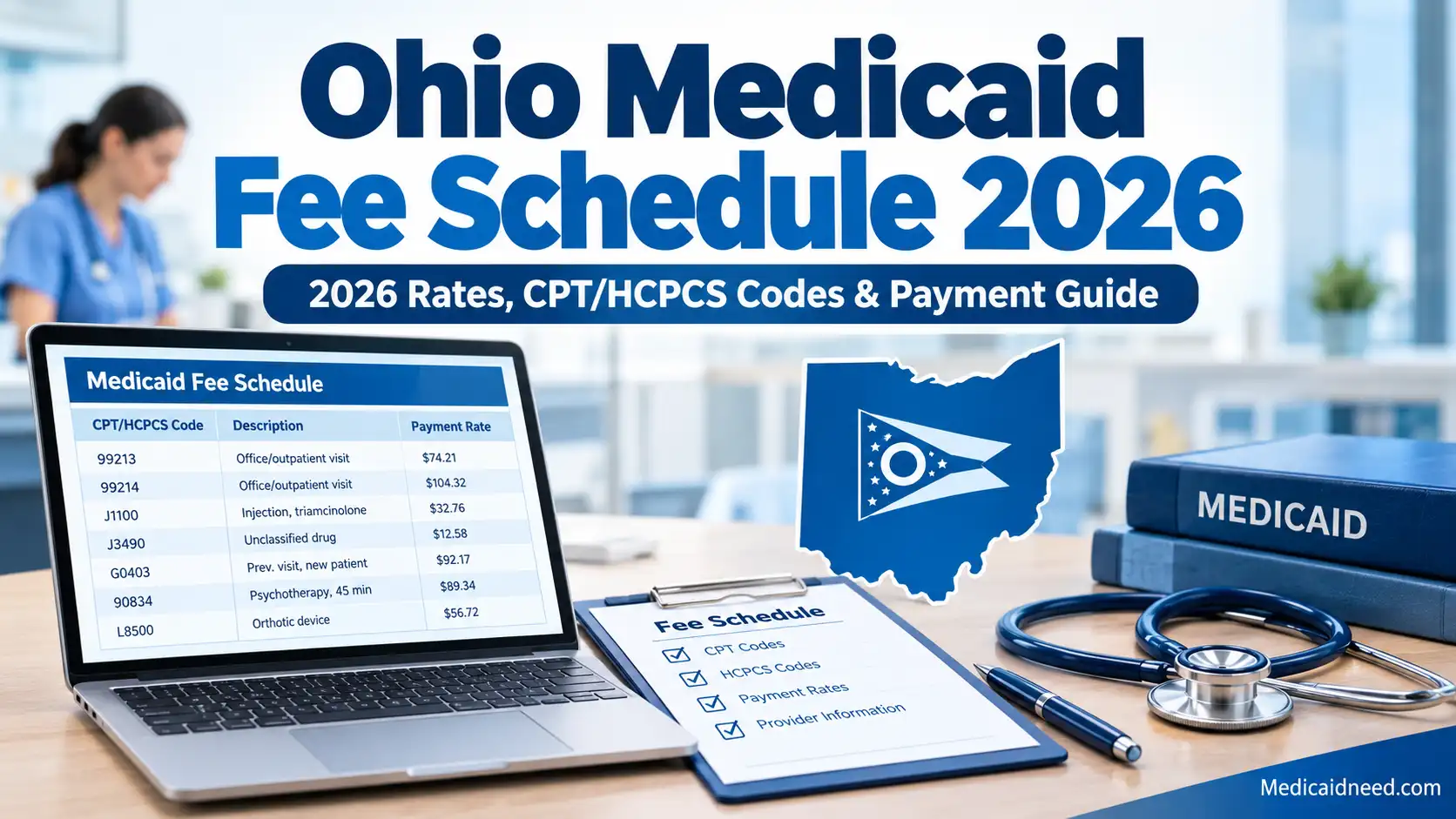
The Ohio Medicaid fee schedule is like a price list. It tells us the most Medicaid will pay for lots of covered medical services, procedures, and supplies. But what you really want to know is simple: what does a rate mean for you, and can a bill still show up?
Here’s a surprise. Ohio doesn’t have just one big rate table for everything. Different dates and payment policies manage different services, and the Ohio Administrative Code sets the bigger changes. Rule 5160-1-60 started on January 1, 2026. It explains how maximum payment amounts work, including CPT and HCPCS coding, facility and non-facility rates, and provider charges.
Want to see how other states do it? This state-by-state Medicaid fee schedule breakdown shows that every state does things a little differently.
What Is the Ohio Medicaid Fee Schedule?
Imagine a big folder full of payment info. Ohio uses that folder to decide the Medicaid maximum payment amounts for services, procedures, and supplies that qualify.
One entry in the folder usually has these pieces:
- CPT or HCPCS code
- Service description
- Effective date
- Maximum payment amount
- Facility payment amount
- Non-facility payment amount
- Professional/technical indicators
- Prior-authorization information
- Status or payment changes
For lots of covered services, Medicaid pays the smaller number: either what the provider charged or the Medicaid maximum. Sometimes other payment formulas win over the amounts in the general appendix.
Ohio Medicaid Fee Schedule 2026: Quick Answer
Want an Ohio Medicaid rate for this year? First, find the CPT or HCPCS code, the service, the provider type, and the date of service. Then look at the schedule or payment rule that fits.
Be careful! A number on a third-party website isn’t always the real, current Ohio rate. The schedule, the effective date, the place of service, and the payment method can all change the amount.
Also, a fee schedule amount doesn’t mean Medicaid covers the service. Ohio rules say Medicaid can’t pay for non-covered services. It also can’t pay for covered services that get denied through review or prior authorization.
How to Find an Ohio Medicaid Rate by CPT or HCPCS Code
An Ohio Medicaid fee plan lookup is like a treasure hunt with six steps:
- Find the CPT or HCPCS code. Look on your medical bill, claim, or explanation of benefits. Your provider’s office can tell you too.
- Identify the service. The description has to match what you really got.
- Check the effective date. A 2026 rate doesn’t work for care you got in another year.
- Choose the correct schedule. Physician, DMEPOS, hospital, dental, behavioral-health, pharmacy, and transportation services each have their own payment rules.
- Check the place of service. Facility and non-facility maximums are different for some services.
- Review coverage and authorization separately. A payment amount doesn’t tell you if your claim gets paid.
Ohio calls it a site differential when the payment changes based on where the service happens. Hospitals, skilled nursing facilities, and ambulatory surgery centers can use facility rates. Other places get non-facility rates.
Ohio Medicaid Fee Schedule by Service Type
Payment info changes a lot from one kind of service to the next.
Physician and Professional Services
CPT and HCPCS codes name most professional services. HCPCS is the bigger system, and CPT is its Level I codes for medical procedures and services.
When you look at an Ohio Medicaid physician fee schedule, read the code, effective schedule, modifiers, and place of service first. Then check if a facility or non-facility amount fits.
Hospital Services
Hospitals don’t get paid like a doctor’s office does. Special parts of the Ohio Administrative Code decide hospital payment.
So a number from the physician fee schedule never shows the whole payment for a hospital stay or visit.
Dental Services
Dental claims have their own rules and codes. Use the dental payment schedule, not the medical one.
DMEPOS
DMEPOS means durable medical equipment, prosthetics, orthotics, and supplies. Ohio has special payment rules just for them. When a brand-new HCPCS code shows up, its payment amount can be set under the Medicaid payment rules before the DMEPOS schedules catch up.
Behavioral Health
Behavioral-health services use special payment methods. Before you trust an Ohio Medicaid behavioral health fee schedule entry, double-check the exact service code, provider category, authorization needs, and effective date.
Pharmacy
Pharmacy payment is a whole different world. Comparing it with professional-service amounts doesn’t help at all.
Laboratory, Imaging and Other Services
Lab work, imaging, ambulance, home health, nursing-facility, telehealth, vision, and hearing services also follow special schedules or rules.
Transportation is a good example. Ohio’s rules keep fee-for-service payment separate from payment under an arrangement with a Medicaid managed-care organization.
Does the Ohio Medicaid Fee Schedule Apply to Managed Care?
Not in the same way.
If you’re an Ohio Medicaid member, this might be the most important part of the whole article. A published fee-for-service (FFS) maximum isn’t the same as the rate a provider agreed on with a Medicaid managed-care organization.
Transportation shows how it works. With fee-for-service, providers get the Medicaid maximum that applies. With managed care, payment follows the provider agreement made under Ohio law.
Are you in a managed-care plan? Then start with your plan’s provider network, member materials, and claim information when you look into a payment.
Does a Fee Schedule Rate Mean the Service Is Covered?
Nope. A fee schedule is about payment. Coverage is a totally separate question.
A service can have a payment amount and still hit a bump on one claim. Any of these can cause trouble:
- Eligibility on the date of service
- Medical necessity
- Prior authorization
- Utilization review
- Provider eligibility
- Correct coding
- Claim-processing requirements
- Coverage limitations
- Other payer payments
Eligibility is worth a closer look because it depends on your household. Your Medicaid income limits help decide if you qualify on the day you get care. The new Medicaid work requirements by state can change whether you keep your coverage over time.
Ohio’s current payment rule says Medicaid can’t pay for non-covered procedures, services, and supplies. It also can’t pay for covered services denied through review or prior-authorization steps.
Can an Ohio Medicaid Provider Bill You More Than Medicaid Pays?
Usually, no. For a covered service, a provider can’t bill you for the gap between what Medicaid pays and what the provider charged.
Ohio Administrative Code Rule 5160-1-60 says Medicaid payment for a covered procedure, service, or supply is payment in full. In general, it doesn’t let anyone collect the difference between that payment and the submitted charge. Medicaid copayments that apply are handled separately.
Ohio’s recipient-liability rule says the same thing. Medicaid payment counts as payment in full, with a few listed exceptions and other recipient-liability rules.
Got a bill you didn’t expect? Don’t just believe the amount is right. Look at the claim, then call your Medicaid plan or Ohio Medicaid.
Why Can Two Websites Show Different Ohio Medicaid Rates?
Because they’re often looking at different things! The differences usually come from one of these:
- Effective date
- Fee schedule
- CPT/HCPCS version
- Provider type
- Facility or non-facility classification
- Modifier
- Payment methodology
- Managed-care arrangement
- Historical rate
Always look at a rate together with its code, description, effective date, schedule, and source. A number all by itself proves nothing.
Ohio’s rules also say that certain payment formulas, and payment amounts set somewhere else in the Administrative Code, win over the matching entries in the general appendix.
How to Read an Ohio Medicaid Fee Schedule
Fee schedules look scary at first. Start with the parts that matter most:
| Field | What it means |
|---|---|
| CPT/HCPCS | Identifies the service, procedure, or supply |
| Description | Explains the coded service |
| Effective date | Shows when the payment information applies |
| Maximum payment | Applicable Medicaid maximum |
| Facility rate | May apply at specified facility locations |
| Non-facility rate | May apply at other service locations |
| Modifier/indicator | Can affect how a service is processed |
| Prior authorization | Indicates whether additional approval may be required |
Some entries don’t show a normal dollar amount. In those, the payment depends on another method, on claim info, or on a rule made for that service.
Ohio Medicaid 2026 Updates
The year matters because Medicaid coding and payment info keep changing.
Rule 5160-1-60 started on January 1, 2026. It also explains how new procedure codes get their first maximum amounts, and how CPT and HCPCS coding connects to Ohio Medicaid payment.
Every time you see a current rate, make sure the schedule is latest. Old PDFs, archived webpages, and third-party databases get out of date really fast.
What Does the Ohio Medicaid Fee Schedule Mean for Patients?
Mostly, it shows how Medicaid payment gets figured out. It can’t tell you your bill all by itself.
Fighting a medical charge? Gather these:
- Your Medicaid member information
- Date of service
- Provider name
- CPT/HCPCS code
- Claim or reference number
- Amount billed
- Amount Medicaid or your managed-care plan paid
- Any explanation of benefits or claim statement
Then compare everything with the Ohio Medicaid or managed-care papers that apply.
Think a provider is trying to collect money you don’t owe on a covered service? Ask them to explain it in writing. Call your Medicaid plan or Ohio Medicaid before you pay any surprise balance.
Ohio Medicaid Fee Schedule FAQs
What is the Ohio Medicaid fee schedule?
It’s payment info that sets Medicaid maximum payment amounts for lots of covered services, procedures, and supplies. Ohio uses many payment ways and service-specific policies, not one rate for everything.
How do I find an Ohio Medicaid fee schedule by CPT code?
Check the HCPCS or CPT code and the date of service. Pick the Medicaid plan that fits, then read the amount along with the facility, non-facility, modifier, and authorization info.
How much does Ohio Medicaid pay for CPT 99213?
There’s no one number that’s safe to share until you find the right schedule, effective date, provider and service info, and payment method. Third-party databases show different payments, so trust the current official Ohio Medicaid source.
Does Ohio Medicaid pay doctors directly?
Money goes through the claim and payment system. It doesn’t go to the patient as cash. How exactly it works depends on whether the service is fee-for-service or comes through a managed-care organization.
Can an Ohio Medicaid patient be balance billed?
For covered services, Ohio’s payment policy generally says providers can’t bill you the difference between their submitted charge and what Medicaid paid. Some Medicaid copayments and certain recipient-liability policies still count.
Does a Medicaid fee schedule rate mean Medicaid covers the service?
No. Coverage, medical necessity, prior authorization, eligibility, provider requirements, and claim-processing rules all change whether Medicaid pays a claim.
Why does my Medicaid claim show a different amount from the fee schedule?
Lots of things can cause it: the effective schedule, the submitted charge, facility versus non-facility status, modifiers, third-party insurance, managed-care contracting, claim edits, or another payment method.
What is the difference between FFS and managed-care rates?
FFS means fee-for-service. Payment follows Medicaid payment rules and maximums. Managed-care pay comes from the provider’s agreement with the Medicaid managed-care organization for that service.
What are CPT and HCPCS codes?
HCPCS is a coding system that names healthcare procedures and related services. CPT codes are Level I of HCPCS and name many medical procedures and services. Ohio’s Medicaid payment rule uses these coding ideas inside its payment system.
Conclusion
The Ohio Medicaid Schedule is a lot more than a list of dollar amounts. HCPCS and CPT codes, effective dates, provider types, facility and non-facility rates, coverage rules, prior authorization, fee-for-service payment, and managed care all play a part.
Disclaimer: This guide is for general info purposes and is not legal, medical, billing, or financial advice. Medicaid rates, coverage policies, managed-care contracts, and payment rules can change. For a specific claim or bill, always see the latest detail with Ohio Medicaid, your Medicaid managed-care plan, or your healthcare provider.