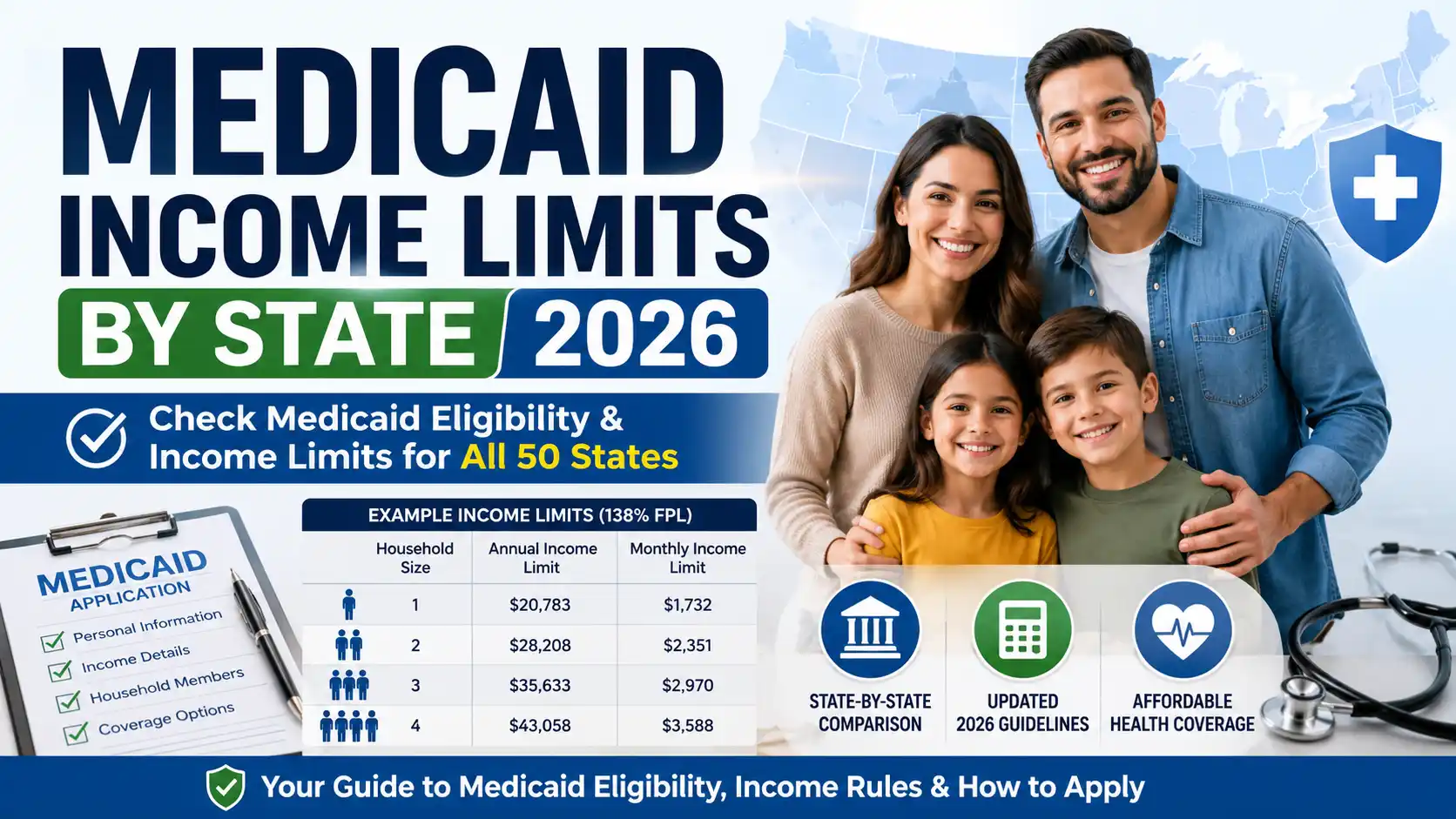
Medicaid is a government health insurance initiative in the United States for families with low budgte. It supports millions of Americans peoples get medical care, doctor visits, hospital treatment, medicines, pregnancy care, and other health services either for free or at a very low cost.
Many people search for Medicaid income limits by state because every state has different rules. Your eligibility depends on:
- Where you live
- How much money your household earns
- How many people live in your home
- Your age
- Pregnancy status
- Disability status
Most states use something called the Federal Poverty guidelines (FPL) to finalize who eligible.
What Are Medicaid Income Limits?
Medicaid income limits are the maximum amount of benefits you can earn while still eligible for Medicaid healthcare coverage.
If your income is below your state’s limit, you may qualify for:
- Free health insurance
- Low-cost doctor visits
- Prescription medicines
- Emergency care
- Pregnancy care
- Children’s healthcare
In most Medicaid expansion states:
- Adults can qualify with income up to 138% of the Federal Poverty Level.
Some states are stricter and only provide Medicaid to:
- Pregnant women
- Children
- Disabled individuals
- Very low-income parents
Medicaid Expansion vs Non-Expansion States
The Affordable Care Act (ACA), also called Obamacare, allowed states to expand Medicaid coverage.
Expansion States
Expansion states allow more adults to eligible for Medicaid, even if they do not have child.
Examples include:
- California
- New York
- Illinois
- Arizona
- Michigan
- North Carolina
These states usually have easier eligibility rules.
Non-Expansion States
Non-expansion states have stricter rules.
Examples include:
- Texas
- Florida
- Kansas
- Wyoming
Moslty non-expansion states, adults without children may not eligible even if they have very low budgte.
See Which States Have New Medicaid Work Requirements
Medicaid Income Limits by State (All 50 States)
The table below shows general adult Medicaid eligibility rules for 2026. Exact income limits can change depending on:
- Family size
- Pregnancy
- Disability
- State programs
| State | Expansion Status | Typical Adult Income Limit |
| Alabama Medicaid Income Limits | No | Limited eligibility |
| Alaska Medicaid Income Guidelines | Yes | 138% FPL |
| Arizona Medicaid Income Limits | Yes | 138% FPL |
| Arkansas Medicaid Income Limits | Yes | 138% FPL |
| California | Yes | 138% FPL |
| Colorado | Yes | 138% FPL |
| Connecticut | Yes | 138% FPL |
| Delaware | Yes | 138% FPL |
| Florida | No | Limited eligibility |
| Georgia | Partial | Restricted pathways |
| Hawaii | Yes | 138% FPL |
| Idaho | Yes | 138% FPL |
| Illinois | Yes | 138% FPL |
| Indiana | Yes | 138% FPL |
| Iowa | Yes | 138% FPL |
| Kansas | No | Limited eligibility |
| Kentucky | Yes | 138% FPL |
| Louisiana | Yes | 138% FPL |
| Maine | Yes | 138% FPL |
| Maryland | Yes | 138% FPL |
| Massachusetts | Yes | 138% FPL |
| Michigan | Yes | 138% FPL |
| Minnesota | Yes | Expanded coverage |
| Mississippi | No | Limited eligibility |
| Missouri | Yes | 138% FPL |
| Montana | Yes | 138% FPL |
| Nebraska | Yes | 138% FPL |
| Nevada | Yes | 138% FPL |
| New Hampshire | Yes | 138% FPL |
| New Jersey | Yes | 138% FPL |
| New Mexico | Yes | 138% FPL |
| New York | Yes | Expanded coverage |
| North Carolina | Yes | 138% FPL |
| North Dakota | Yes | 138% FPL |
| Ohio | Yes | 138% FPL |
| Oklahoma | Yes | 138% FPL |
| Oregon | Yes | 138% FPL |
| Pennsylvania | Yes | 138% FPL |
| Rhode Island | Yes | 138% FPL |
| South Carolina | No | Limited eligibility |
| South Dakota | Yes | 138% FPL |
| Tennessee | No | Limited eligibility |
| Texas | No | Very limited |
| Utah | Yes | 138% FPL |
| Vermont | Yes | 138% FPL |
| Virginia | Yes | 138% FPL |
| Washington | Yes | 138% FPL |
| West Virginia | Yes | 138% FPL |
| Wisconsin | Partial | Different rules |
| Wyoming | No | Limited eligibility |
How Medicaid Calculates Income
A lot of people get confused about how Medicaid checks income.
Medicaid usually uses MAGI.
What Is MAGI?
MAGI means Modified Adjusted Gross Income.
This includes:
- Job salary
- Self-employment income
- Unemployment benefits
- Some Social Security income
- Investment income
Some benefits may not count, such as:
- SNAP benefits
- SSI payments
- Some veteran benefits
Is Medicaid Based on Gross or Net Income?
For most people, Medicaid uses MAGI-based income rules.
This starts with your adjusted gross income from your tax return.
However, seniors and nursing home Medicaid programs may use different financial rules and may also check:
- Savings
- Assets
- Property
- Bank accounts
Get Your State’s 2026 Medicaid Fee Schedule →
Medicaid Income Limits by Household Size
The number of members in your family affects how much income you can make.
For example:
- A single adult has a lower income limit
- A family of four can earn more money and still qualify
Example Household Scenarios
| Household Size | Eligibility Threshold Tends To |
| 1 person | Lower income limit |
| 2 people | Moderate increase |
| 4 people | Much higher limit |
| 6+ people | Significantly higher |
This is why mostly households often qualify even when single person alone might not.
Medicaid for Children and Pregnant Women
Children and pregnant women usually have higher income limits than regular adult Medicaid.
Many states allow children to qualify at:
- 200% FPL
- 250% FPL
- Sometimes even higher
Pregnant women may also qualify even if household income is above the normal adult Medicaid limit.
This helps families get:
- Pregnancy care
- Child doctor visits
- Vaccinations
- Hospital care
Medicaid for Seniors and Disabled Individuals
Medicaid also helps seniors and people with disabilities.
These programs are different because they may check:
- Savings
- Property
- Assets
- Long-term care needs
Many seniors use Medicaid to help pay for:
- Nursing homes
- Long-term care
- Home healthcare services
Some families work with:
- Medicaid planners
- Elder law attorneys
- State assistance offices
because the rules can be complicated.
What Happens if Your Income Is Too High?
Even if your income is too high for Medicaid, you may still have other options.
Alternatives to Standard Medicaid
ACA Marketplace Plans
You may qualify for low-cost Obamacare health insurance with monthly subsidies.
CHIP Coverage
Children may still qualify for CHIP even if parents do not qualify for Medicaid.
Spend-Down Medicaid
Some states allow people with high medical bills to still qualify.
Medicaid Waivers
Certain disability or long-term care programs use special eligibility policies.
Medicaid Eligibility for Self-Employed and Gig Workers
People with changing income often worry about Medicaid eligibility.
This includes:
- Freelancers
- Uber or Lyft drivers
- Seasonal workers
- Small business owners
States usually check your estimated yearly income instead of just one paycheck.
Keeping good tax records and income documents is important.
What if Your Income Changes Mid-Year?
Your Medicaid eligibility can change if your income changes.
You should report:
- New jobs
- Overtime pay
- Marriage
- Divorce
- Household changes
If you do not report changes:
- Your Medicaid could stop
- Your renewal may be delayed
- You may receive incorrect benefits
How to Apply for Medicaid
Step 1: Check Your State Medicaid Agency
Every state has its own Medicaid website and rules.
Many people search:
- Medicaid office near me
- Medicaid help near me
- Medicaid enrollment assistance near me
Step 2: Gather Documents
You may need:
- Pay stubs
- Tax returns
- ID card
- Social Security number
- Proof of address
Step 3: Submit an Application
Most states allow applications:
- Online
- By phone
- By mail
- In person
Step 4: Complete Verification
The state may ask for more information to check your income or identity.
Step 5: Wait for Approval
Approval time based on the state and your situation.
Pregnancy Medicaid and emergency Medicaid are often processed faster.
Medicaid vs Medicare vs CHIP
| Program | Main Purpose | Who It Covers |
| Medicaid | Low-income healthcare | Families, adults, seniors |
| Medicare | Federal senior insurance | Adults 65+ |
| CHIP | Children’s insurance | Children in moderate-income families |
Some seniors qualify for both Medicare and Medicaid. This is called dual eligibility.
Common Medicaid Application Mistakes
1. Reporting the Wrong Income
Many people confuse:
- Gross income
- Net income
- MAGI income
This can lead to denial.
2. Ignoring Household Rules
The number of dependents and household numbers matters.
3. Missing Renewal Deadlines
Medicaid must usually be renewed every year.
4. Forgetting to Report Income Changes
Income increases or new jobs can affect eligibility.
5. Assuming Every State Uses the Same Rules
Each state Medicaid agency has different policies.
Can You Appeal a Medicaid Denial?
Yes. If your Medicaid application is denied:
- Read the denial letter carefully
- Check whether your income was calculated correctly
- Submit missing documents
- Request a fair hearing if necessary
Common reasons for denial include:
- Missing paperwork
- Incorrect income information
- Failure to respond to notices
States With the Broadest Medicaid Access
Some states provide wider Medicaid coverage than others.
Examples include:
- California (Medi-Cal)
- New York Medicaid
- Massachusetts Medicaid
- Oregon Health Plan
- Washington Apple Health
These states often offer:
- Easier adult eligibility
- Expanded healthcare programs
- Better low-income coverage options
Helpful Resources
For the updated Medicaid income limits for all States, eligibility criteria, and application process, see these official and helpful resources:
- Centers for Medicare & Medicaid Services (CMS)
- HealthCare.gov Medicaid Information
- Medicaid Income Limits for All 50 States
FAQs (Medicaid Income Limits by State)
What is the monthly income limit for Medicaid?
The monthly limit based on your living state, household numbers, and category. Most expansion states use 138 percent of the Federal Poverty Level for young people.
Which states expanded Medicaid?
Many states expanded Medicaid under the ACA, including California, New York, Illinois, Michigan, and North Carolina.
Can adults without children get Medicaid?
Yes, in most expansion states. Non-expansion states may not cover adults without children.
Does Social Security count as Medicaid income?
Some taxable Social Security income may count depending on the Medicaid program.
What if I make too much for Medicaid?
You may still qualify for:
- ACA Marketplace subsidies
- CHIP
- Spend-down Medicaid
- Medicaid waivers
Can self-employed people qualify for Medicaid?
Yes. Medicaid Eligibility is usually denepda on your estimated yearly income after deductions.
How often do Medicaid income limits change?
Medicaid Income guidelines usually change every year after new Federal Poverty Level changes.
Can students qualify for Medicaid?
Yes. College students with low income may qualify depending on their state.
Can immigrants get Medicaid?
Eligibility based on immigration status and state-specific policies and changes.
Conclusion
Medicaid income limits are different across all 50 States. Your eligibility based on:
- Your income
- Household size
- State rules
- Age
- Pregnancy status
- Disability status
Mostly Medicaid expansion states allow adults to qualify at up to 138 percent of the Federal Poverty guidelines, while non-expansion states have stricter rules.
Before applying:
- Calculate your income carefully
- Check your state Medicaid website
- Keep your documents ready
- Report income changes quickly
- Watch renewal deadlines
Understanding Medicaid rules can supports you get affordable healthcare coverage for yourself and your household without unnecessary delays or confusion.