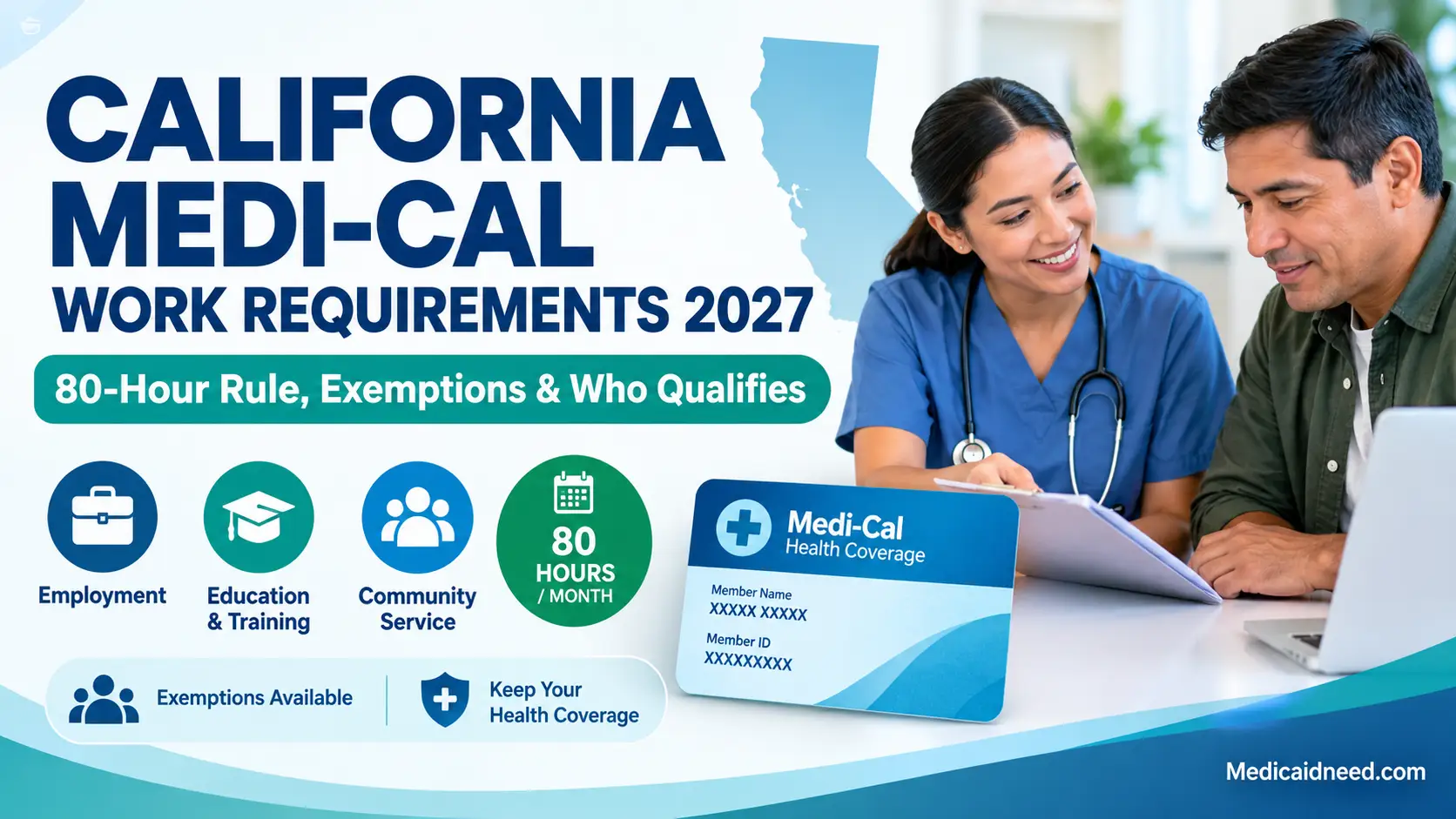
California Medi-Cal work requirements start on January 1, 2027, for certain adults ages 19 to 64. These adults have to work, go to school, join approved job training, volunteer, or do a mix of these to keep their Medi-Cal coverage. Some people can meet the rule by earning at least $580 per month, based on the guidance published so far.
The rule comes from a federal law passed in 2025. It only applies to certain Medicaid groups, so not everyone on Medi-Cal needs a job. Kids, many older adults, pregnant people, parents of young children, and some people with disabilities or serious health problems may be exempt.
Here’s the good news. If you learn the rules, find out whether you’re exempt, and answer every letter you get, you can keep your coverage. Want to see how other places are handling this? Check out new Medicaid work requirements by state.
What Are California Medi-Cal Work Requirements for 2027?
They are new federal rules for who can sign up for Medicaid and who can keep it. Some adults now have to prove they work or take part in approved community activities.
Starting January 1, 2027, California will require adults in the expanded Medi-Cal group under the Affordable Care Act to follow these new rules. The same exemptions and other guidelines still apply. Medi-Cal, managed by the Department of Health Care Services (DHCS), has all the official info.
Here’s what the requirement asks for:
- To stay eligible, you’ll need to do at least 80 hours each month of approved activities—things like working a job, doing community service, or taking part in a recognized job training program.
- Earn at least $580 per month from qualifying employment, under the guidance published so far.
- Go to school at least half-time, or mix different qualifying activities to reach the goal.
- Send papers or information when the county Medi-Cal office asks. Don’t skip this one.
Important: The $580 number is the one published right now. Nobody can promise it will stay the same all through 2027. Check the latest official Medi-Cal work rules for updates.
Who Must Meet the New Medi-Cal Work Rules?
Mostly adults ages 19 to 64 who get Medi-Cal through the ACA adult expansion group and don’t have an exemption.
Your age isn’t the only thing that matters. Your Medi-Cal group, your health, and your family situation count too. A lot of people guess wrong about this.
The rule may apply to you if you:
- Are between 19 and 64 years old
- Get Medi-Cal through the ACA adult expansion group
- Don’t have an exemption
- Apply for coverage, or reach your renewal, after the new rules start for your case
Some people on California’s state-funded immigrant coverage may also be affected by how the state sets things up. Don’t guess based on immigration status. Look at your Medi-Cal group instead. Not sure what an expansion group is? The guide to Medicaid expansion by state in 2027 explains it.
How Many Hours Must You Work to Keep Medi-Cal?
Most adults under this rule need 80 hours of qualifying activities each month. The other way is to meet the monthly earnings amount.
The hours don’t have to come from one place. Depending on your case, you can combine a job, approved training, school, and community service.
| Qualifying activity | General requirement |
|---|---|
| Paid employment | Meet the applicable earnings threshold or qualifying hours rules |
| Job training | Generally 80 hours per month |
| Volunteer work or community service | Generally 80 hours per month |
| Education | Enrollment at least half-time may satisfy the requirement |
| Combined activities | Combine qualifying activities to meet the applicable threshold |
These are general descriptions of the published rules. Exact definitions, ways of checking, and exceptions can change how your hours count.
Example: Working Part-Time
Say a person works part-time and earns at least $580 in one month. Under the California guidance published so far, that may be enough. They wouldn’t have to work 80 hours.
Now think about someone who works fewer hours but also volunteers at a community group. Together, that might reach the goal. Whether it counts depends on the program rules. These are just examples, not promises that anyone is eligible.
Who Is Exempt From California Medi-Cal Work Requirements?
Some groups don’t have to follow the new work rules, according to California’s published guidance. If you think you’re in one of these groups, make sure your county Medi-Cal office has the right information about you.
The state says these groups are exempt:
- Children: People ages 18 and younger.
- Older adults: People age 65 and older.
- Pregnant people: During pregnancy and for one year after.
- Parents and caregivers: Anyone taking care of kids ages 0–13.
- People with disabilities: People who meet the disability exemption rules.
- People with serious health conditions: Some serious physical or mental health conditions, or substance use problems.
- Recently incarcerated individuals: People who got out of jail or prison in the last 90 days.
- Medicare beneficiaries: Anyone enrolled in Medicare Part A or Part B.
- American Indians and Alaska Natives: People covered by that exemption.
- Former foster youth: People under age 26 who were in foster care on their 18th birthday.
What If You Have a Medical Condition?
A health condition can get you an exemption. But having a diagnosis isn’t enough all by itself. The rules treat normal health problems differently from conditions that meet the exemption rules.
If your health makes it hard to work, go to school, or volunteer, call your county Medi-Cal office. Ask which exemption fits you. Also ask if you need medical records or a note from your doctor.
Don’t just assume you’re exempt. Check.
Are Parents With Children Exempt?
Yes, if the child is 0 to 13. California’s published guidance exempts parents and caregivers of kids that age. Call your county office and make sure your household information is up to date.
Kids grow up fast, though. When your child turns 14, or things change at home, ask if you’re still exempt.
When Do California Medi-Cal Work Requirements Start?
The date for the whole state is January 1, 2027. Your own start date depends on whether you’re applying or already have Medi-Cal.
| Situation | General timing |
|---|---|
| New applications | Requirements begin applying to relevant applications submitted on or after January 1, 2027 |
| Existing members | The requirement generally applies at the applicable renewal during 2027 |
| Renewals due in January or February 2027 | California’s published implementation guidance says these members will not be assessed for the requirement until their next scheduled renewal in 2028 |
| Renewals due March 2027 onward | The requirement is expected to be assessed at applicable renewals, subject to the rules for the individual case |
Source: DHCS (1-29-2026)
The state also plans to check affected people more often. So don’t count on the statewide date alone. Your renewal notice shows your real deadline.
How Will California Verify Work Requirement Compliance?
The state will look at your case information, electronic records, and other allowed ways of checking. Then it decides if you meet the rule or qualify for an exemption.
The records that help depend on your life. Pay stubs or papers from your employer are a good start. So is proof of self-employment income, school records, job-training records, and volunteer or community service logs. If you need an exemption, medical papers or other proof might be needed too.
Save copies of everything that shows what you do. Then ask your county office which papers it accepts and how to send them.
One more thing that’s good to know. California’s published guidance says that through December 31, 2027, people may be allowed to self-attest to qualifying activities. That means telling the state yourself what you did. This only works when the state can’t confirm it from case information or electronic sources. It doesn’t cancel the paperwork rules, so follow your notice.
What Happens If You Do Not Meet the Medi-Cal Work Requirements?
If the rule applies to you and the state can’t confirm that you follow it or have an exemption, your coverage could be denied. You could also lose the coverage you have now.
Federal rules require that you get a notice and a chance to prove you’re following the rules or qualify for an exemption before decisions go against you. The details—when, how, and what you need to do—depend on your notice. Medicaid rules and payment rates aren’t the same everywhere, so the Medicaid fee schedule by state can help if you want to compare.
If a letter about work requirements shows up:
- Read the whole thing.
- Find the deadline to respond.
- Figure out if you meet the requirement or have an exemption.
- Gather the records it asks for.
- Call your county Medi-Cal office if something doesn’t make sense.
- Send what they need fast, and keep proof that you sent it.
If your coverage ends, call the county office right away. Ask why it ended and what review or appeal options you have. You may also be able to reapply.
How to Prepare for the 2027 Medi-Cal Changes
Don’t wait until January 2027 to get ready. A few small steps now will make life easier later.
- Check your Medi-Cal eligibility category. Find out if you’re in the ACA adult expansion group or a different one.
- Review possible exemptions. Do you have a qualifying medical condition? Do you care for a young child or get Medicare? Ask how your exemption should be written down.
- Keep relevant records. Save papers about your job, school, training, and volunteering if they apply.
- Watch for official letters. Keep your mailing address, phone number, and other contact info up to date with your county office.
- Check the official guidance regularly. California can change its steps, and details shift.
For the most trusted information, visit the California DHCS Medi-Cal Changes page and the official Medi-Cal Help Center.
FAQs About California Medicaid Work Requirements
1. When do California Medi-Cal work requirements start in 2027?
January 1, 2027. They affect certain adults ages 19–64 who get Medi-Cal through the ACA adult expansion group and don’t have an exemption. Most current members meet the requirement at an applicable renewal, not on January 1.
2. How many hours do you have to work to qualify for Medi-Cal in 2027?
Most affected adults need 80 hours per month of qualifying activities, or they need to meet the applicable earnings threshold. California’s published guidance lists $580 per month right now. Approved education, job training, volunteering, and mixes of these can count too.
3. Can you keep Medi-Cal if you are unemployed?
Yes, if you have an exemption or meet the requirement another way. School, approved job training, or community service can count. Your county office can tell you which one fits.
4. Are people with disabilities exempt from Medi-Cal work requirements?
Yes, if they meet the disability exemption rules. Some serious physical or mental health conditions can qualify too, but not every condition does. Ask your county Medi-Cal office what papers you need.
5. Are parents exempt from the 2027 Medi-Cal work rules?
If you’re a parent or caregiver for kids ages 0–13, you don’t have to follow these rules in California. Just double-check that your county office has your current household details on file.
6. Will seniors have to meet Medi-Cal work requirements?
No. Adults 65 and older are also exempt, as well as anyone with Medicare Part A or B. But don’t forget—other Medi-Cal requirements and renewal deadlines still matter.
7. Can you lose Medi-Cal for not meeting the work requirement?
Yes. If these rules apply to you and you don’t qualify for an exemption, you could lose your coverage. So, pay attention to any notices you get, respond on time, send in what they request, and call your county office if something doesn’t seem right.
8. Do existing Medi-Cal members need to comply in January 2027?
Not always. California’s published implementation guidance says members with renewals due in January or February 2027 won’t be checked until their next renewal in 2028. Renewals starting in March 2027 are expected to include the new check.
9. Where can you check your California Medi-Cal work requirement status?
Start with the official Medi-Cal Changes page. Then call your county Medi-Cal office. They can tell you if the rule applies to you, if you can get an exemption, and what you need to send.
Conclusion
Nobody wants to wake up one morning and find out they lost their health coverage because they missed a letter. So, check your mail. Make sure your phone number is up-to-date. If something looks off, pick up the phone and call your county office right away.
Official Resources
- Check Your Work Rules Now — DHCS Medi-Cal Changes
- Find Your County Office Fast — California DHCS
- See the Official 2027 Timeline — DHCS Federal Impacts
- Update Your Info Today — BenefitsCal
Disclaimer: Here, you’ll find an overview of California Medi-Cal work requirements coming in 2027. The rules aren’t set in stone and could shift, so what applies to you really depends on your circumstances and the specific program. Make sure you check your own situation with the California Department of Health Care Services or your local Medi-Cal office—don’t just take general advice for granted.