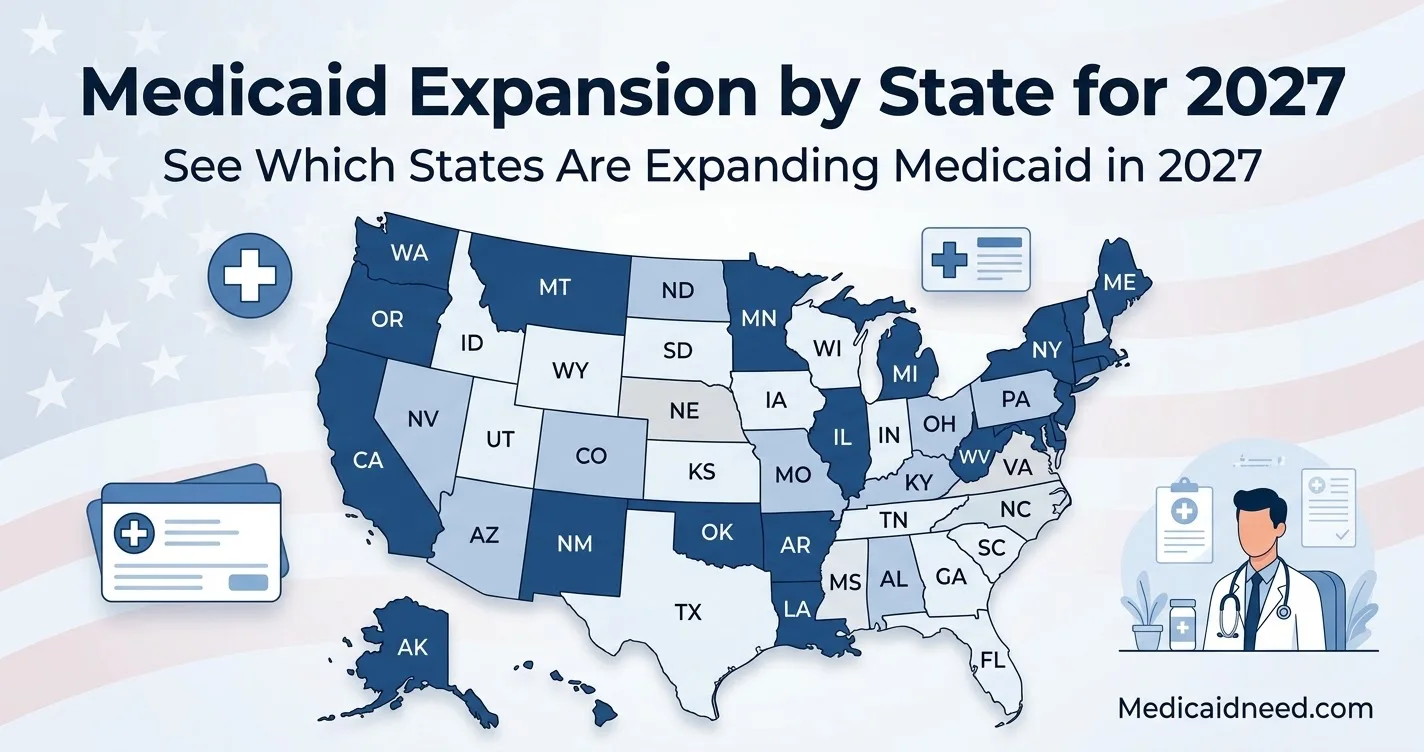
As of September 2026, 41 states — including Washington, D.C. — have adopted the Affordable Care Act (ACA) Medicaid expansion. Ten states haven’t. The expansion generally covers eligible adults up to 138% of the federal poverty level, subject to state and federal rules.
But the map alone doesn’t tell you much about 2027. That’s the year several federal Medicaid changes actually kick in: community-engagement requirements for certain adults, six-month eligibility redeterminations for applicable expansion adults, and a shorter retroactive-coverage window. Knowing your state’s status is step one. Knowing what changes underneath it is the part people miss.
Medicaid Expansion States in 2027
The ACA expansion was built to reach low-income adults who’d fallen through the cracks — people without dependent children, without a disability, without any traditional pathway into Medicaid.
CMS’s latest available Medicaid enrollment data puts the count at 41 expansion states and 10 non-expansion states.
The 41 Medicaid Expansion States
| State | Status |
|---|---|
| Alaska Medicaid Expansion | Expanded |
| Arizona Medicaid Expansion | Expanded |
| Arkansas | Expanded |
| California Medi-Cal Expansion | Expanded |
| Colorado | Expanded |
| Connecticut | Expanded |
| Delaware | Expanded |
| Hawaii | Expanded |
| Idaho | Expanded |
| Illinois | Expanded |
| Indiana | Expanded |
| Iowa | Expanded |
| Kentucky | Expanded |
| Louisiana | Expanded |
| Maine | Expanded |
| Maryland | Expanded |
| Massachusetts | Expanded |
| Michigan | Expanded |
| Minnesota | Expanded |
| Missouri | Expanded |
| Montana | Expanded |
| Nebraska | Expanded |
| Nevada | Expanded |
| New Hampshire | Expanded |
| New Jersey | Expanded |
| New Mexico | Expanded |
| New York | Expanded |
| North Carolina | Expanded |
| North Dakota | Expanded |
| Ohio | Expanded |
| Oklahoma | Expanded |
| Oregon | Expanded |
| Pennsylvania | Expanded |
| Rhode Island | Expanded |
| South Dakota | Expanded |
| Utah | Expanded |
| Vermont | Expanded |
| Virginia | Expanded |
| Washington | Expanded |
| West Virginia | Expanded |
| Washington, D.C. | Expanded |
KFF’s August 2026 tracker lands on the same number independently — 41 jurisdictions, D.C. included, with the ACA expansion adopted.
The 10 States Without Full ACA Medicaid Expansion
Alabama, Florida, Georgia, Kansas, Mississippi, South Carolina, Tennessee, Texas, Wisconsin, and Wyoming.
That’s the list. Ten states, no more, no less, based on the latest 2026 tracking.
Not expanding doesn’t mean no Medicaid exists there. Every state runs a Medicaid program. What differs — sometimes sharply — is who qualifies as an adult without kids or a disability.
Why Georgia and Wisconsin Need Special Treatment
A tidy “41 expanded, 10 didn’t” list flattens some real differences. Two states in particular don’t fit the mold cleanly.
Georgia runs Georgia Pathways to Coverage, a Section 1115 waiver program with its own eligibility rules and community-engagement provisions built in. It’s a distinct animal from full ACA expansion, not a substitute for it.
Wisconsin sits in its own category too. It never adopted full ACA expansion, yet its existing Medicaid program already covers certain adults up to the poverty line. KFF points out that this structure means Wisconsin avoids the coverage-gap problem that plagues most other non-expansion states.
So if you live in either state, don’t extrapolate from the general non-expansion rules. Check your state’s actual eligibility criteria — Medicaid income limits vary enough between states that assumptions will cost you.
What Medicaid Expansion Means for Eligibility in 2027
The ACA expansion created what’s called the new adult group — generally, adults with household income up to 138% of the federal poverty level (FPL) in expansion states.
Here’s where people get tripped up: 138% FPL isn’t a universal Medicaid ceiling. It’s specific to the expansion pathway.
Medicaid runs on multiple eligibility tracks, and income limits shift depending on which one applies to you:
- Adults covered through the expansion group
- Parents and caretaker relatives
- Children
- Pregnant people
- Older adults
- People with disabilities
- Medically needy individuals
- Other state-specific categories
Eligibility for the expansion group generally runs on Modified Adjusted Gross Income (MAGI) rules. Your household size, income, state, age, and category all factor into the final answer — none of them alone.
What Changes for Medicaid in 2027?
Three changes matter more than the rest.
1. Community-Engagement Requirements
Beginning January 1, 2027, states must roll out community-engagement requirements for certain Medicaid beneficiaries — though some states can start earlier.
If it applies to you, federal guidance points to 80 hours per month of qualifying activity. That can mean work, education, community service, or approved job-training activities.
This isn’t blanket. The rules don’t apply the same way to every beneficiary, and exemptions matter a lot here. Being on Medicaid doesn’t automatically mean an 80-hour requirement lands on your plate — check the new Medicaid work requirements by state before assuming either way.
2. Six-Month Medicaid Renewals
Starting in 2027, applicable ACA expansion adults shift from annual renewals to six-month eligibility redeterminations, with specified exceptions and implementation details still being worked out state by state.
Practically, that means twice the paperwork frequency for some beneficiaries. Renewal isn’t a rubber stamp — miss one, and coverage can lapse.
Keep these current, always:
- Address
- Phone number
- Household information
- Income information
- Required documents, organized and ready
CMS guidance already includes worked examples of six-month eligibility periods starting in 2027.
3. Retroactive Medicaid Coverage Changes
Another shift lands January 1, 2027.
For people qualifying through Medicaid expansion, retroactive coverage will generally cap at one month before the application date. Traditional Medicaid eligibility groups keep a two-month retroactive window under the federal change.
Translation: waiting to apply costs more than it used to. If you think you qualify, apply now rather than later.
Do Medicaid Expansion Adults Have to Work in 2027?
Not necessarily.
The community-engagement rules target certain applicable individuals — not every single Medicaid recipient across the board.
Qualifying activities can include:
- Employment
- Community service or volunteering
- Certain education programs
- Certain job-training activities
CMS allows these to be combined to hit the monthly total.
Exclusions and exceptions exist too, and they’re not uniform. Your state Medicaid agency is the final word on whether the requirement touches your case.
What Is the Medicaid Coverage Gap?
The coverage gap hits low-income adults in states that skipped ACA expansion — a specific, painful middle zone.
In an expansion state, an eligible adult typically qualifies for Medicaid around that 138% threshold. In a non-expansion state, the same person might earn too much for traditional Medicaid categories while earning too little for subsidized Marketplace coverage. Caught in between, with no clean path to either.
KFF estimated roughly 1.2 million uninsured people sat in this gap across the 10 non-expansion states, per its July 2026 analysis.
Numbers move state to state, and individual circumstances matter — but the gap itself is real and well documented.
Expansion vs. Non-Expansion Medicaid
| Feature | Expansion State | Non-Expansion State |
|---|---|---|
| ACA adult expansion | Yes | No |
| Expansion eligibility | Generally up to 138% FPL | Not available as full ACA expansion |
| Childless adults | May qualify through expansion | Often subject to other eligibility categories |
| Coverage gap risk | Generally lower | Can be significant |
| State-specific rules | Still apply | Traditional categories are important |
| 2027 changes | Applicable expansion adults may be affected | Some waiver populations may also be affected |
Medicaid, in short, is not one program wearing fifty different hats. It’s fifty programs with a shared federal skeleton.
How to Check Medicaid Eligibility in 2027
Run through this if you’re applying now or checking whether coverage continues:
- Identify your state.
- Check whether it adopted ACA Medicaid expansion.
- Determine your household size.
- Calculate current household income under applicable Medicaid rules.
- Identify your likely eligibility category.
- Check whether 2027 community-engagement rules apply to you.
- Review exemptions or exceptions that might apply.
- Apply through your state’s official Medicaid agency or approved enrollment system.
- Respond promptly to renewal notices and verification requests.
A Medicaid calculator can estimate where you land, but it’s an estimate — not an official determination. For a more granular look at provider payment differences by state, the Medicaid fee schedule by state is worth a look too, especially if you’re weighing coverage against access to care.
State-Level Medicaid Resources
Medicaid runs on a federal-state partnership, which means your state agency — not a national office — holds your application, your renewal date, and your specific eligibility rules.
Useful searches to run:
- Medicaid eligibility [state] 2027
- Medicaid income limit [state] 2027
- Medicaid renewal [state]
- Medicaid application [state]
- Medicaid work requirements [state]
- [State] Medicaid office
Names vary by state, too. Michigan calls it the Healthy Michigan Plan. California runs Medi-Cal. Wisconsin has BadgerCare Plus. Pennsylvania uses Medical Assistance. North Carolina operates NC Medicaid.
Common Medicaid Expansion Mistakes
Watch for these assumptions — they trip people up constantly:
- “138% FPL is everyone’s Medicaid limit.” It applies to the ACA expansion pathway only, not every category.
- “Non-expansion means there’s no Medicaid.” Every state has Medicaid. Adult eligibility is what varies.
- “Everyone on Medicaid must work 80 hours.” The 2027 rules target specified populations, with exceptions built in.
- “Renewal is always once a year.” Not for applicable expansion adults starting in 2027 — six months, not twelve.
- “A non-expansion state means I can’t qualify.” You might still qualify through another category entirely.
- “Georgia and Wisconsin are identical to other non-expansion states.” They’re not. Their structures require separate consideration.
- “Missing an application date doesn’t matter.” It does now more than ever, with the 2027 retroactive-coverage limits.
2027 Medicaid Checklist
Have these ready before you apply or renew:
- State of residence
- Household size
- Current income information
- Identification and requested documents
- Current mailing address
- Phone and email
- Existing Medicaid case information
- Renewal notices
- Details about work, education, or qualifying activities, if applicable
- Documentation your state has requested
If you’re already covered, don’t let a renewal notice sit unopened. That’s how coverage lapses.
Official Resources
- Check Your Medicaid Eligibility — Medicaid.gov
- Apply for Marketplace Coverage — HealthCare.gov
- Verify 2027 Policy Updates — CMS.gov
- See State-by-State Data — KFF
FAQs
What states have Medicaid expansion in 2027?
As of Now, 41 states — including Washington, D.C. — have adopted ACA Medicaid expansion. The 10 without full expansion are Alabama, Florida, Georgia, Kansas, Mississippi, South Carolina, Tennessee, Texas, Wisconsin, and Wyoming.
What is the Medicaid expansion income limit?
Generally 138 percent of the federal poverty guidelines for eligible adults. The exact number based on family size, MAGI policies, your state, and other requirement factors.
Does Texas have Medicaid expansion?
No. Texas is one of the 10 states that hasn’t adopted ACA Medicaid expansion, based on the latest 2026 tracking.
Does Florida have Medicaid expansion?
No. Florida hasn’t adopted ACA Medicaid expansion either, as of the latest state tracking.
Does Medicaid renew every six months in 2027?
For applicable ACA expansion adults, yes — generally. The shift from annual to six-month redeterminations begins in 2027, subject to federal exceptions and how each state implements it.
How many hours do you have to work for Medicaid in 2027?
For those subject to the community-engagement eligibility, federal guidance generally points to 80 hours per 30 days. Work, education, community service, and qualifying training can all count toward it. Exceptions apply.
Can unemployed adults qualify for Medicaid?
Potentially, yes. It comes down to state, monthly household income, eligibility category, and individual circumstances. In 2027, community-engagement rules may factor in for certain expansion adults specifically.
What happens if my state hasn’t expanded Medicaid?
You may still qualify through a traditional eligibility category. If not, Marketplace coverage or another health coverage option becomes the next step to investigate.
Is Medicaid expansion the same in every state?
No. Federal rules set the framework, but states run the programs — which means different pathways, waivers, procedures, and implementation timelines depending on where you live.
Conclusion
Forty-one states expanded, ten didn’t — but that number was never the whole story. Eligibility, work rules, recertificatin timing, retroactive coverage: all of it shifts based on where you live and which category you fall into.
Start with your state. Find your pathway. And when in doubt, let your state Medicaid agency have the final say — policies change, and the agency is the one place that’s always current.
Disclaimer: This article is for general guidance purposes only and is not an official Medicaid eligibility determination or legal/medical advice. Medicaid policies vary by state and can change. Always confirm your eligibility, recertification requirements, and 2027 rules with CMS, Medicaid.gov, or your state Medicaid agency.