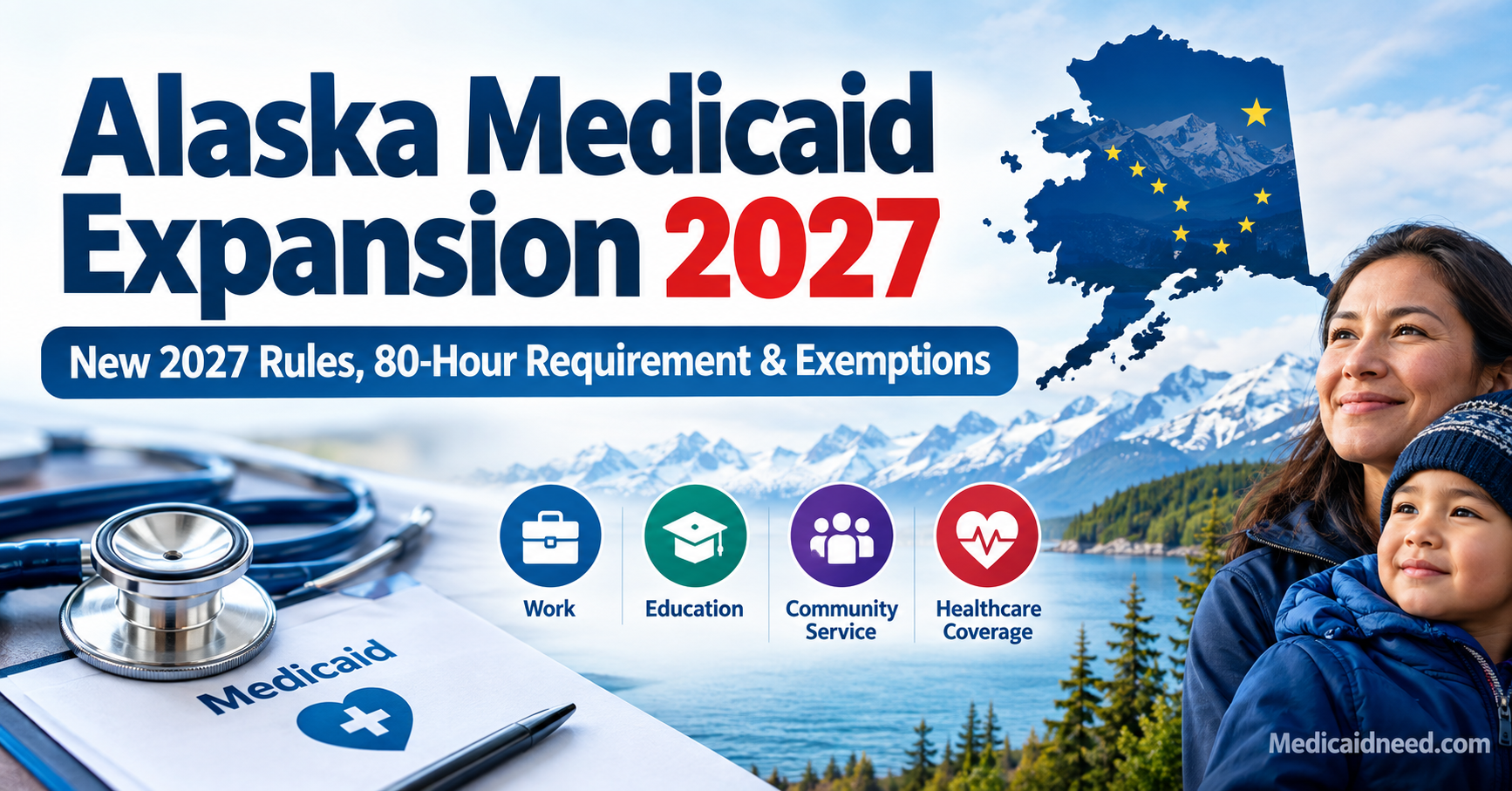
Alaska Medicaid is changing in 2027. But that doesn’t mean Alaska is starting Medicaid expansion from scratch — the state already expanded Medicaid back in 2015. What’s actually new is a federal Work and Community Engagement Requirement (WCER) that will affect certain adults covered through the expansion group.
The policies are currently expected to begin January 1, 2027. Alaska has asked the federal government for more time to implement them, though, so if a later date gets approved, the Alaska Division of Public Assistance (DPA) says it will notify recipients directly.
Here’s the one thing worth remembering before anything else: not everyone on Alaska Medicaid will have to meet this new requirement.
Is Alaska Medicaid Expansion Ending in 2027?
No. New work and community-engagement rules don’t erase the expansion itself.
The Medicaid expansion group generally covers low-income adults ages 19 through 64 who qualify through the expansion category — not through another pathway like pregnancy, disability, or age. WCER applies only to certain people within that group. Falling in the 19–64 range doesn’t automatically pull you into the requirement.
| Medicaid Expansion | WCER |
|---|---|
| An eligibility pathway | A requirement that may apply to certain expansion adults |
| Alaska’s expansion began in 2015 | New federal rules begin in 2027 |
| Helps determine whether someone can qualify | Determines whether an affected person meets the engagement requirement |
| Does not equal a work requirement | Does not apply to every Medicaid recipient |
Who May Be Affected by Alaska Medicaid Changes in 2027?
The new rules center on adults ages 19–64 receiving Medicaid through the expansion group. If WCER applies to you specifically, you may need to show qualifying work, education, job training, volunteer or community service, or meet an applicable income pathway.
Before any of that, though, Alaska checks whether an exclusion, exception, or temporary hardship applies to your situation. DPA has also said it will lean on information it already has before asking you for more paperwork — worth knowing if you’re dreading a mountain of forms.
Does being 19–64 automatically trigger the rule? No. Age is just one piece. Other eligibility categories and exclusions can mean WCER simply doesn’t apply to you. And because Medicaid eligibility and WCER get determined person by person, one household member could be subject to the rule while another isn’t.
For a broader look at how these mandates vary across the country, see new Medicaid work requirements by state.
Alaska Medicaid 80-Hour Work Requirement
If WCER applies to you, the federal standard is 80 hours of qualifying activity per month. There’s more than one road to get there — Alaska’s current guidance allows activities to be combined, and certain education or income pathways can satisfy the rule on their own.
| Activity or pathway | Can it satisfy WCER? |
|---|---|
| Paid employment | Yes |
| Self-employment | Potentially, if requirements can be verified |
| Job training | Yes, when qualifying |
| Education | Yes |
| Volunteer/community service | Yes |
| Combination of qualifying activities | Yes |
| Half-time education | May satisfy the education pathway |
| Qualifying household income | May satisfy the income pathway |
The federal income pathway is based on 80 hours multiplied by the federal minimum wage. At $7.25 per hour, that comes out to $580 per month. If your income sits near that line, it’s worth checking Alaska’s Medicaid income limits to see exactly where you stand.
Can I combine different activities? Yes. If your qualifying hours don’t come from one single source, Alaska’s guidance allows you to stack different activities toward the 80-hour standard.
Does school count? Yes. Someone enrolled at least half-time, as defined by their school, can satisfy the education pathway outright. Enrolled less than half-time? Those hours can still count toward the general 80-hour total.
Does self-employment count? It can, when the work or income meets the requirements and can be verified. Seasonal and fluctuating work — common in Alaska — may also qualify.
Who Is Exempt From Alaska Medicaid Work Requirements?
Exclusions are arguably the most important part of this whole policy. People who may qualify include:
- Alaska Native and American Indian individuals meeting the applicable federal definition
- Certain former foster youth under age 26
- Parents, guardians, caretaker relatives, and family caregivers who meet specific criteria
- Veterans with qualifying total disability ratings
- People who are medically frail or have qualifying special medical needs
- People already subject to applicable SNAP work rules
- People complying with TANF work requirements
- Individuals participating in qualifying drug or alcohol treatment and rehabilitation
- People meeting applicable public-institution criteria
- Pregnant individuals, and those entitled to postpartum medical assistance
Requirements differ by category, and an exclusion simply means WCER doesn’t apply for that covered period.
Alaska Native and American Indian Medicaid recipients. Individuals meeting the applicable federal definition are excluded from WCER entirely. DPA may pull from information it already has to confirm status, and self-attestation is sometimes accepted.
Pregnancy and postpartum coverage. Pregnant individuals, and those entitled to postpartum medical assistance during the applicable window, are excluded from WCER.
Caregivers. A parent, guardian, caretaker relative, or family caregiver may qualify for an exclusion while caring for a dependent child age 13 or younger, or a disabled individual. Even when the exclusion doesn’t apply, some caregiving work may still count as qualifying unpaid activity.
Disability and medical conditions. People who are medically frail or have qualifying special medical needs may receive an exclusion — and the condition doesn’t have to be visible to count. Not receiving Social Security disability benefits, by itself, doesn’t rule someone out of this exclusion either.
Temporary Hardships in Alaska
Some Alaskans won’t need a permanent exclusion — just a temporary hardship pass. Current guidance identifies several qualifying situations:
- Inpatient or institutional care
- Certain intensive medical or behavioral-health services
- Traveling outside the community for medically necessary care
- Living in a qualifying federally declared disaster area
- Living in an area meeting the federal high-unemployment standard
Alaska currently sets that high-unemployment threshold at 6.45% or higher. Some hardships need to be requested; others may get applied automatically based on information DPA already has.
These provisions matter more in Alaska than almost anywhere else, honestly, given how different life looks in urban Anchorage versus a remote village accessible only by plane or boat.
How Will Alaska Verify the Requirements?
DPA starts with reliable information it already has on file. Only when that’s insufficient does it ask for more, covering things like:
- Work and hours
- Income
- Education
- Job training
- Volunteer or community service
- Other qualifying activities
- Exemption or hardship circumstances
Self-attestation is sometimes accepted, but it depends entirely on what’s being verified. Keep copies of anything you submit, and respond to official notices by their deadlines — missing a date is where most people run into trouble.
Do I Have to Report Work Every Month?
Not necessarily. Once DPA determines you’re eligible and have met WCER, you generally won’t need to report your activities monthly. DPA reviews WCER again during the standard Medicaid renewal process, starting with information it already has on hand.
If more is needed, you’ll get a notice explaining exactly what’s required and by when. Keeping your mailing address, phone number, and email current with DPA isn’t optional busywork here — it’s how you actually receive that notice.
Six-Month Medicaid Renewal vs. WCER
These get confused constantly, but they’re not the same thing. A renewal checks whether you still qualify for Medicaid at all. WCER is a separate, additional requirement layered on top for certain expansion adults.
Most people in the expansion population will see six-month reviews. Alaska Native and American Indian individuals in that group keep a 12-month renewal cycle instead. And being excluded from WCER doesn’t automatically exempt you from the six-month review — they run on separate tracks.
| Issue | Six-month renewal | WCER |
|---|---|---|
| Main purpose | Recheck Medicaid eligibility | Verify required engagement for applicable people |
| Applies to | Based on Medicaid eligibility group | Certain expansion adults |
| Same requirement? | No | No |
| Can exemptions matter? | Eligibility rules still apply | Yes |
| Review timing | Depends on eligibility group | Reviewed according to WCER rules and renewal process |
What Happens If WCER Requirements Are Not Met?
If WCER applies to you and DPA can’t establish that you met it — or that you qualify for an exclusion, exception, or hardship — your application could be denied, or coverage could end at renewal.
It’s not as blunt as “miss 80 hours, lose Medicaid instantly,” though. DPA has to weigh applicable exclusions, exceptions, and hardships first, and follow required notice procedures before anything takes effect. If you think DPA got it wrong, your notice will explain your appeal rights and how to request a fair hearing.
Coverage that ends isn’t necessarily gone for good, either — eligibility gets reviewed again if you later meet WCER or qualify under another Medicaid rule.
Alaska Medicaid Expansion 2027: What Should You Do Now?
There’s no need to assume automatic coverage loss in 2027. Instead:
- Check which Medicaid eligibility group you’re enrolled in
- Watch for official DPA notices
- Keep your address, phone number, and email updated
- Review whether an exclusion or hardship could apply to you
- Keep records of qualifying work, school, training, or volunteer activity if WCER applies
- Respond to information requests by the stated deadline
- Rely on official Alaska resources as your situation changes
The federal implementation date currently sits at January 1, 2027 — but since Alaska has requested more time, watch for updated state guidance before making any assumptions. For a state-by-state comparison of how expansion itself is evolving, check Medicaid expansion by state in 2027.
What About Alaska Medicaid Changes in 2028?
Don’t mix this up with a separate change coming later. New Medicaid expansion-group copayment provisions are scheduled for 2028, not 2027. Anyone researching “Alaska Medicaid 2027 changes” should keep the work/community-engagement rules and the later copayment changes filed separately in their head — and for background on how those payment structures work, the Medicaid fee schedule by state is a useful reference point.
Alaska Medicaid Expansion 2027: Coverage Impact Projections
Alaska’s February 2026 modeling used 61,169 Medicaid expansion enrollees ages 19–64 as its baseline, and ran two scenarios:
| Modeling scenario | Projected coverage loss |
|---|---|
| Scenario 1 | 13,611 people (22.3%) |
| Scenario 2 | 9,452 people (15.5%) |
These are projections, not confirmed outcomes. Alaska itself calls the estimates preliminary, and notes that enrollment trends, federal guidance, and implementation details could all shift the final numbers.
For the most current word on any of this, rely on the Alaska Department of Health, the Division of Public Assistance, and StayCovered Alaska — not older summaries floating around online.
Official Resources
- Apply or Renew Your Medicaid Coverage — Alaska Division of Public Assistance
- Check Your Medicaid Renewal Status — StayCovered Alaska
- Verify Your Eligibility Requirements — Alaska Medicaid Program
- Find Health Coverage Options — HealthCare.gov
FAQs
When do Alaska Medicaid work requirements start?
The current federal implementation date is January 1, 2027. Alaska has requested more time, so that date could shift if the request is approved.
Does everyone on Alaska Medicaid have to work?
No. WCER applies only to certain adults in the expansion group. Other Medicaid eligibility groups aren’t automatically subject to it.
How many hours are required for Alaska Medicaid?
80 hours of qualifying activity per month is the general standard. Education and income pathways can also satisfy it.
Does volunteering count for Alaska Medicaid?
Yes, qualifying volunteer or community service counts toward WCER when it meets the applicable requirements.
Do Alaska Native and American Indian people have to meet WCER?
No. Anyone meeting the applicable federal definition is excluded from WCER under current guidance.
Are pregnant people exempt from Alaska Medicaid work requirements?
Yes. Pregnant individuals and those entitled to postpartum medical assistance are excluded.
Does school count toward the Alaska Medicaid requirement?
Yes. Qualifying half-time enrollment can satisfy the education pathway on its own.
Do I have to report my work every month?
Generally, no. DPA reviews WCER again at renewal, though you may need to submit information if your compliance can’t be verified from existing records.
Are six-month Medicaid renewals the same as WCER?
No. A six-month review checks Medicaid eligibility. WCER is a separate requirement for certain expansion adults.
Can Medicaid be denied if WCER is not met?
Yes — if WCER applies and DPA can’t establish compliance or an applicable exclusion, exception, or hardship. Notice and appeal procedures still apply.
Conclusion
Alaska Medicaid Expansion 2027 isn’t the end of anything — it’s a new layer of requirements for a specific slice of the expansion population. The 80-hour standard is the headline number, but education, income, combined activities, exclusions, and hardships all shape how it actually plays out for real people.
If there’s one habit worth building now, it’s this: keep your contact information current with DPA and open every notice that arrives. That single step will do more to protect your coverage than anything else on this list. For a fuller picture of how these policies compare to income requirements more broadly, the Medicaid income limits page is a solid next stop.
Disclaimer: This article is for general guidance purposes only and does not constitute legal, medical, or benefits advice. Alaska Medicaid rules and implementation details may change. Always verify your individual situation with the Alaska Department of Health or Division of Public Assistance.