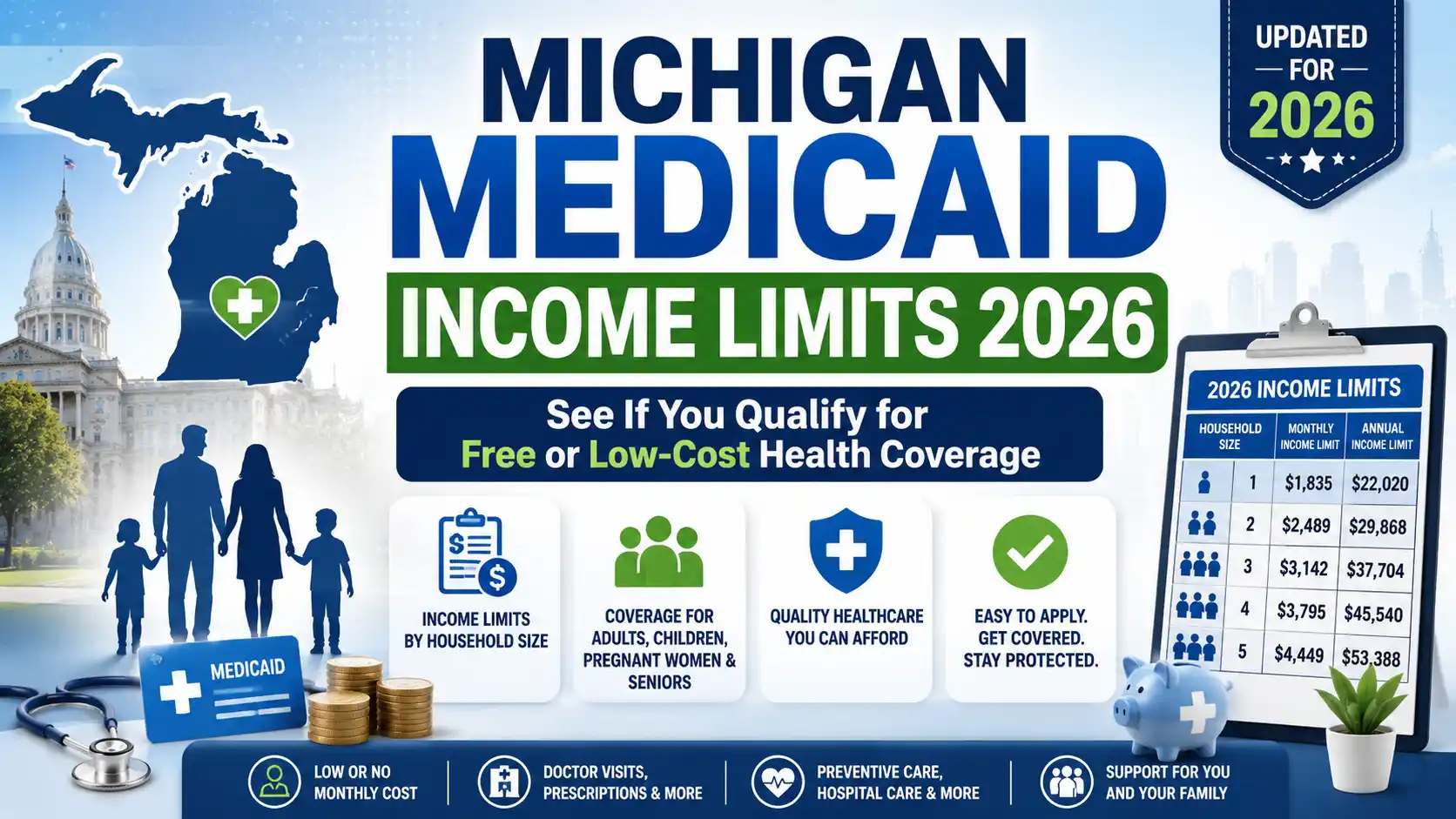
Michigan Medicaid income limits helps minimum wages residents get healthcare coverage, including doctor visits, hospital expenses, prescriptions, and and other medical services. Your eligibility depends on income, asset size, age, and the Medicaid program you apply for.
What Are Michigan Medicaid Income Limits?
Michigan Medicaid income limits are the maximum income limits allowed to qualify for Medicaid coverage.
Many adults qualify through the Healthy Michigan Plan, which is based on about 138 percent of the Federal Poverty Level (FPL).
Income limits depend on:
- Household size
- Monthly income
- Annual income
- Medicaid program
- Age or disability status
Michigan Medicaid Income Limits Chart 2026
| Household Size | Monthly Income Limit | Annual Income Limit |
|---|---|---|
| 1 | $1,835 | $22,020 |
| 2 | $2,489 | $29,868 |
| 3 | $3,142 | $37,704 |
| 4 | $3,795 | $45,540 |
| 5 | $4,449 | $53,388 |
Who Qualifies for Michigan Medicaid?
Michigan Medicaid may cover:
- Low income adults
- Kids
- Pregnant women
- Seniors
- People with disabilities
- Nursing home residents
Applicants generally must:
- Live in Michigan
- Meet income requirements
- Be a U.S. citizen or qualifying immigrant
Understanding the Healthy Michigan Plan
The Healthy Michigan Plan is Michigan’s Medicaid Expansion program for young people ages 19 to 64.
Benefits include:
- Doctor visits
- Hospital care
- Emergency services
- Prescription drugs
- Mental health services
It is the most common Medicaid program for working adults.
Medicaid Income Limits for Children
Children may qualify under higher income limits than adults.
Programs include:
- Medicaid for Children
- MIChild coverage
Coverage may include checkups, dental care, vision care, and hospital services.
Medicaid for Pregnant Women
Pregnancy Medicaid helps cover:
- Prenatal care
- Lab tests
- Delivery costs
- Postpartum care
Because income limits are higher during pregnancy, many women qualify even if some time they do not qualify for regular Medicaid.
Medicaid for Seniors and Disabled Adults
These programs may consider both income and assets.
Coverage may include:
- Doctor visits
- Prescription drugs
- Long-term care
- Home healthcare
Michigan Medicaid Asset Limits
Programs Without Asset Tests
These programs usually do not check savings:
- Healthy Michigan Plan
- Children’s Medicaid
- Pregnancy Medicaid
Programs With Asset Tests
Some senior and long term care programs may review:
- Cash
- Savings accounts
- Investments
- Stocks and bonds
What Counts as Income for Michigan Medicaid?
Michigan usually uses Modified Adjusted Gross Income (MAGI).
Income may include:
- Wages
- Self-employment income
- Unemployment benefits
- Retirement income
- Investment income
Gross Income vs Net Income
Medicaid generally apply gross income before taxes, not take home pay.
Self-Employment and Gig Worker Income
Gig workers and freelancers may still qualify.
Examples include:
- Uber drivers
- Lyft drivers
- DoorDash drivers
- Freelancers
- Online sellers
Keep records of income and business expenses when applying.
What Happens If Your Income Changes?
If your income increases, you may:
- Keep Medicaid
- Move to another Medicaid program
- Qualify for Marketplace insurance subsidies
Report changes through MI Bridges as soon as possible.
Michigan Medicaid vs Marketplace Insurance
| Feature | Medicaid | Marketplace Plan |
|---|---|---|
| Premiums | Usually free | Monthly premium |
| Deductibles | Low or none | Varies |
| Eligibility | Lower income | Wider income range |
How to Apply for Michigan Medicaid
Step 1: Gather Documents
You will need:
- ID
- Social Security number
- Proof of Michigan residency
- Income documents
Step 2: Submit an Application
Apply through:
- MI Bridges
- Local Medicaid offices
- Enrollment assistance organizations
Step 3: Receive a Decision
You may be:
- Approved
- Asked for more information
- Denied with appeal rights
Medicaid Renewal and Reporting Requirements
To keep coverage:
- Report income changes
- Update your address
- Complete renewal forms
- Respond to MDHHS notices
Medicaid Assistance Across Michigan
Free help is available in:
- Detroit
- Grand Rapids
- Lansing
- Ann Arbor
- Flint
- Warren
- Dearborn
- Livonia
Community health centers and MDHHS offices can help with applications.
Common Mistakes to Avoid
- Using net income instead of gross income
- Missing renewal deadlines
- Not reporting income change
- Forgetting household members
- Assuming all programs have asset limits
Helpful Resources
FAQs (Michigan Medicaid income limits)
What is the Michigan Medicaid income limit for one person?
For many young people, the monthly income limit is about $1,835.
Does Michigan Medicaid check bank accounts?
Some programs do, especially long term care Medicaid. Many standard programs focus mainly on income.
Is Medicaid based on monthly or yearly income?
Michigan Medicaid may use both monthly and annual income depending on the program.
Can I own a home and still qualify for Medicaid?
Yes. Owning a home does not automatically disqualify you.
Can I get Medicaid if I work full time?
Yes. Many full time workers qualify through the Healthy Michigan Plan.
What happens if I make too much money for Medicaid?
You may also acceptable for subsidized Marketplace health insurance.
What is MAGI?
MAGI stands for Modified Adjusted Gross Income. This method is used for determing eligibility for many Medicaid programs.
Conclusion
Michigan Medicaid guides health services coverage for young, kids, pregnant women, people with high age and disable persons. Understanding Michigan Medicaid income limits, income rules, and application requirements can help you decide if you qualify and get the coverage you need.