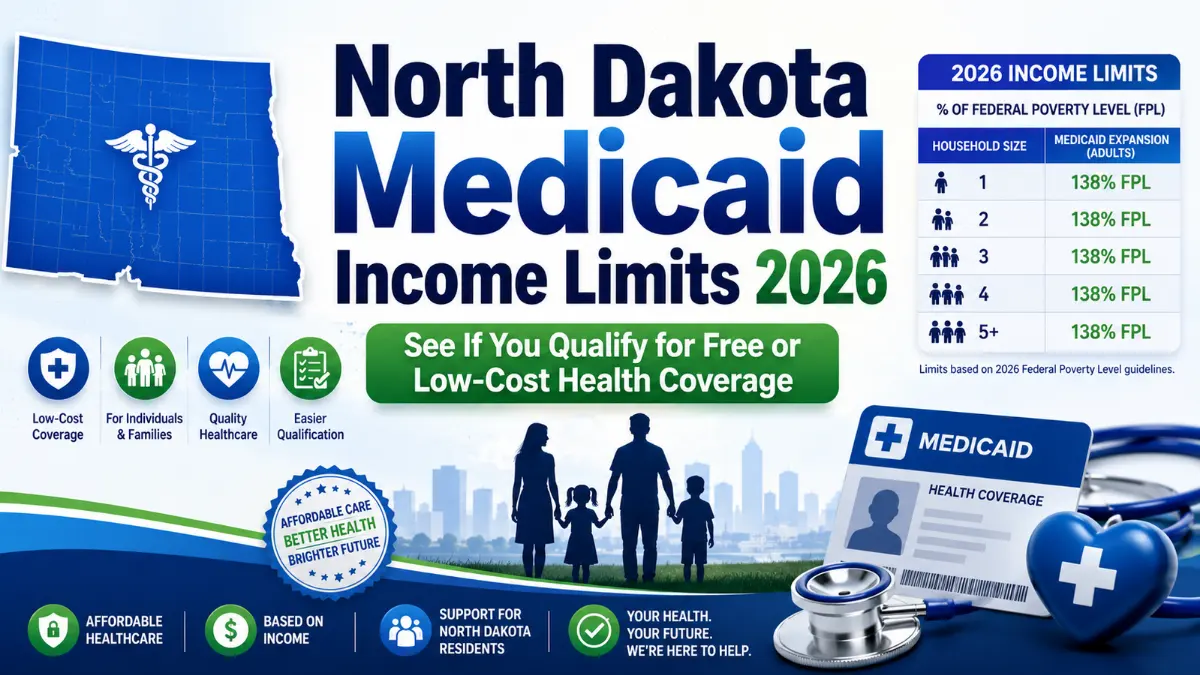
North Dakota Medicaid income limits are the maximum income amounts individuals and families can earn while still qualifying for Medicaid health coverage. These limits are based on household size, income, age, disability status, pregnancy status, and other eligibility factors.
For most adults under age 65, eligibility is determined through Medicaid Expansion under the Affordable Care Act (ACA), which allows qualifying residents to receive comprehensive health coverage at little or no cost.
If you live in Fargo, Bismarck, Grand Forks, Minot, Williston, Dickinson, Jamestown, or anywhere else in North Dakota, the same statewide eligibility standards generally apply.
North Dakota Medicaid Income Limits Chart
The following chart reflects common Medicaid Expansion income guidelines based on household size.
| Household Size | Annual Income Limit | Monthly Income Limit |
|---|---|---|
| 1 | $20,783 | $1,732 |
| 2 | $28,207 | $2,351 |
| 3 | $35,632 | $2,969 |
| 4 | $43,056 | $3,588 |
| 5 | $50,480 | $4,207 |
| 6 | $57,905 | $4,825 |
| 7 | $65,329 | $5,444 |
| 8 | $72,754 | $6,063 |
These figures are generally tied to 138 percent of the Federal Poverty Level (FPL), which is commonly used for Medicaid Expansion eligibility.
Who Qualifies for Medicaid in North Dakota?
Several groups may qualify for Medicaid coverage.
Adults Ages 19 to 64
Adults may qualify if they:
- Live in North Dakota
- Meet citizenship or qualified immigration requirements
- Have income within Medicaid limits
- Need health coverage
Many working adults who previously did not qualify are now eligible because of Medicaid Expansion.
Children
Children often qualify under higher income thresholds than adults. Even if parents do not qualify, children may still be eligible through Medicaid or the Children’s Health Insurance Program (CHIP).
Pregnant Women
Pregnancy-related Medicaid programs typically offer broader income eligibility and provide coverage for prenatal care, delivery services, and postpartum care.
Seniors
Adults age 65 and older may qualify through specialized Medicaid programs that consider both income and, in some cases, assets.
Individuals with Disabilities
People who are blind, disabled, or require long-term care services may qualify under separate eligibility categories with different rules.
Understanding Medicaid Expansion in North Dakota
Medicaid Expansion changed healthcare access for thousands of residents across North Dakota. Before expansion, many adults without dependent children were not eligible for Medicaid regardless of how low their income was.
Today, Medicaid Expansion helps:
- Working adults
- Self-employed individuals
- Part-time workers
- Individuals between jobs
- Adults without children
This program plays a major role in providing affordable healthcare coverage throughout the state.
What Income Counts for Medicaid?
One of the most common sources of confusion involves determining what income actually counts.
North Dakota generally uses Modified Adjusted Gross Income (MAGI) methodology for most Medicaid eligibility determinations.
Income that may count includes:
- Wages
- Salaries
- Self-employment income
- Unemployment benefits
- Certain Social Security benefits
- Pension income
- Investment income in some situations
Gross Income vs Take Home Pay
Many applicants mistakenly use their take-home pay.
Medicaid eligibility usually relies on MAGI calculations rather than the amount deposited into your bank account after deductions.
This mistake can lead people to incorrectly assume they qualify or do not qualify.
How Household Size Affects Eligibility
Household size directly impacts income limits.
Generally, a household may include:
- You
- Your spouse
- Tax dependents
- Children claimed on tax returns
A larger household receives a higher income threshold.
Example: Single Adult
Sarah lives alone in Fargo and earns approximately $18,000 annually. Because her income falls below the single-person limit, she may qualify for Medicaid coverage.
Example: Family of Four
A family in Bismarck consisting of two parents and two children earns $40,000 annually. Because the household income falls below the family-of-four threshold, they may qualify for Medicaid benefits.
Example: Working Parent
A single parent in Grand Forks works full-time and earns $30,000 annually while supporting two children. Depending on household composition and program eligibility, the children may qualify even if the parent does not.
What Benefits Does North Dakota Medicaid Cover?
Coverage may include:
- Doctor visits
- Preventive care
- Emergency services
- Hospital stays
- Laboratory testing
- Prescription medications
- Mental health services
- Substance use treatment
- Pediatric care
- Maternity services
Coverage varies by eligibility category and medical need.
How to Apply for North Dakota Medicaid
Applying for Medicaid is usually straightforward when you prepare the necessary documents beforehand.
Step 1: Gather Documentation
Collect:
- Photo identification
- Social Security numbers
- Proof of North Dakota residency
- Pay stubs
- Tax documents
- Immigration documents if applicable
Step 2: Complete an Application
Applications may be submitted through state enrollment systems or approved assistance channels.
Step 3: Verify Information
You may need to provide additional documentation verifying:
- Income
- Household size
- Residency
- Citizenship status
Step 4: Wait for Determination
After verification, the state reviews eligibility and issues a determination.
Step 5: Respond to Follow-Up Requests
Missing paperwork is one of the most common reasons applications experience delays.
How Long Does Medicaid Approval Take?
Processing times vary depending on:
- Application volume
- Completeness of documentation
- Verification requirements
- Household circumstances
Submitting complete documentation upfront often speeds up approval.
Common Reasons Medicaid Applications Are Denied
Understanding common denial reasons can help applicants avoid mistakes.
Incorrect Income Reporting
Using net income instead of MAGI can create eligibility issues.
Missing Documents
Failure to provide requested records frequently delays or prevents approval.
Household Errors
Incorrectly reporting household members may affect eligibility calculations.
Residency Issues
Applicants must generally meet North Dakota residency requirements.
Missed Deadlines
Failure to respond to requests for information can result in denial.
What Happens if Your Income Changes?
Income changes can affect Medicaid eligibility.
You should report:
- New employment
- Salary increases
- Job loss
- Reduced work hours
- Changes in household composition
Reporting changes promptly helps avoid coverage interruptions and potential overpayment issues.
Medicaid Renewal Process
Qualifying once does not guarantee permanent coverage.
North Dakota periodically reviews eligibility through a renewal process.
To maintain coverage:
- Review renewal notices carefully
- Update household information
- Submit requested documents on time
- Report income changes promptly
Many people lose coverage simply because paperwork is not completed correctly.
Medicaid vs Marketplace Insurance
Some residents earn too much to qualify for Medicaid but still need affordable coverage.
In those situations, Marketplace plans may be an alternative.
| Feature | Medicaid | Marketplace Plans |
|---|---|---|
| Monthly Premiums | Often none | May apply |
| Income Requirements | Lower income limits | Higher income ranges |
| Subsidies | Not applicable | Available |
| Out-of-Pocket Costs | Usually lower | Varies by plan |
| Enrollment Assistance | Available | Available |
When Medicaid Is Usually Better
- Income falls below Medicaid limits
- You want minimal healthcare costs
- You qualify for public assistance programs
When Marketplace Coverage May Be Better
- Income exceeds Medicaid limits
- You qualify for premium tax credits
- Employer-sponsored insurance is unavailable
Do Assets Count for Medicaid?
For many Medicaid Expansion applicants, assets are not the primary eligibility factor.
However, asset limits may apply for:
- Long-term care Medicaid
- Nursing home coverage
- Certain disability programs
- Some senior Medicaid categories
This distinction is important because many applicants mistakenly assume all Medicaid programs use the same rules.
Quick Eligibility Checklist
You may qualify if you can answer “yes” to most of these questions:
- Do you live in North Dakota
- Are you a U.S. citizen or qualified immigrant?
- Is your household income below applicable limits?
- Are you applying under an eligible category?
- Can you verify your income and residency?
If so, submitting an application may be worthwhile.
Tips to Improve Your Chances of Approval
Keep Records Organized
Maintain copies of:
- Pay stubs
- Tax returns
- Identity documents
- Verification letters
Verify Household Information
Double-check every person included on the application.
Report Changes Quickly
Timely reporting prevents future eligibility complications.
Don’t Assume You Are Ineligible
Many working adults qualify under Medicaid Expansion.
Statewide Availability
Medicaid eligibility rules generally apply statewide.
Residents in:
- Fargo
- Bismarck
- Grand Forks
- Minot
- Williston
- Dickinson
- Jamestown
All follow the same statewide eligibility framework. Local enrollment assistance may be available through community health clinics, enrollment specialists, and North Dakota Health and Human Services offices.
Official & Helpful Resources
- Health and Human Services North Dakota
- Medicaid Income Limits for All 50 States
- North Dakota Medicaid Eligibility
FAQs ( North Dakota Medicaid income limits)
What is the Medicaid income limit for a single person in North Dakota?
A single adult may qualify if annual income is approximately $20,783 or less under Medicaid Expansion guidelines.
What is the Medicaid income limit for a family of four?
A family of four may qualify with annual income up to approximately $43,056, depending on current eligibility standards.
Does North Dakota have Medicaid Expansion?
Yes. North Dakota participates in Medicaid Expansion under the Affordable Care Act, allowing more adults to qualify for healthcare coverage.
Can I get Medicaid if I work full-time?
Yes. Many full time workers qualify if their household income remains within Medicaid eligibility limits.
Is Medicaid based on gross income or net income?
Most Medicaid Expansion determinations use Modified Adjusted Gross Income (MAGI), not take-home pay.
Do children have different income limits?
Yes. Children often qualify under higher income thresholds through Medicaid or CHIP programs.
What is MAGI?
MAGI stands for Modified Adjusted Gross Income, a calculation used to determine eligibility for many Medicaid programs.
Can my child qualify if I don’t?
Yes. Children may qualify even when parents exceed adult Medicaid income limits.
What happens if my income increases?
An income increase may affect eligibility. Changes should be reported promptly to avoid coverage issues.
How often does Medicaid verify income?
Income may be reviewed during renewals, eligibility checks, and when reported changes occur.
Are income limits different in Fargo or Bismarck?
No. Medicaid income limits generally apply statewide throughout North Dakota.
Can seniors qualify for Medicaid?
Yes. Seniors may qualify through specialized Medicaid programs that use different eligibility rules.
Do assets count for Medicaid eligibility?
Assets may not matter for Medicaid Expansion but can be important for long-term care and certain senior programs.
How long does Medicaid approval take?
Approval timelines vary depending on documentation, verification requirements, and application volume.
What documents are needed to apply?
Applicants commonly need identification, proof of residency, Social Security information, and income documentation.
Conclusion
North Dakota Medicaid provides an important healthcare safety net for low income adults, children, pregnant women, seniors, and individuals with disabilities. Understanding income limits, household size calculations, and MAGI rules can help you determine whether you qualify and avoid common application mistakes.
If your income falls within the applicable guidelines, gathering your documents and applying as soon as possible is often the best next step. Even if you believe your income may be too high, it is worth reviewing your eligibility carefully, as Medicaid Expansion, CHIP, and Marketplace subsidies may provide affordable health coverage options for you and your family.