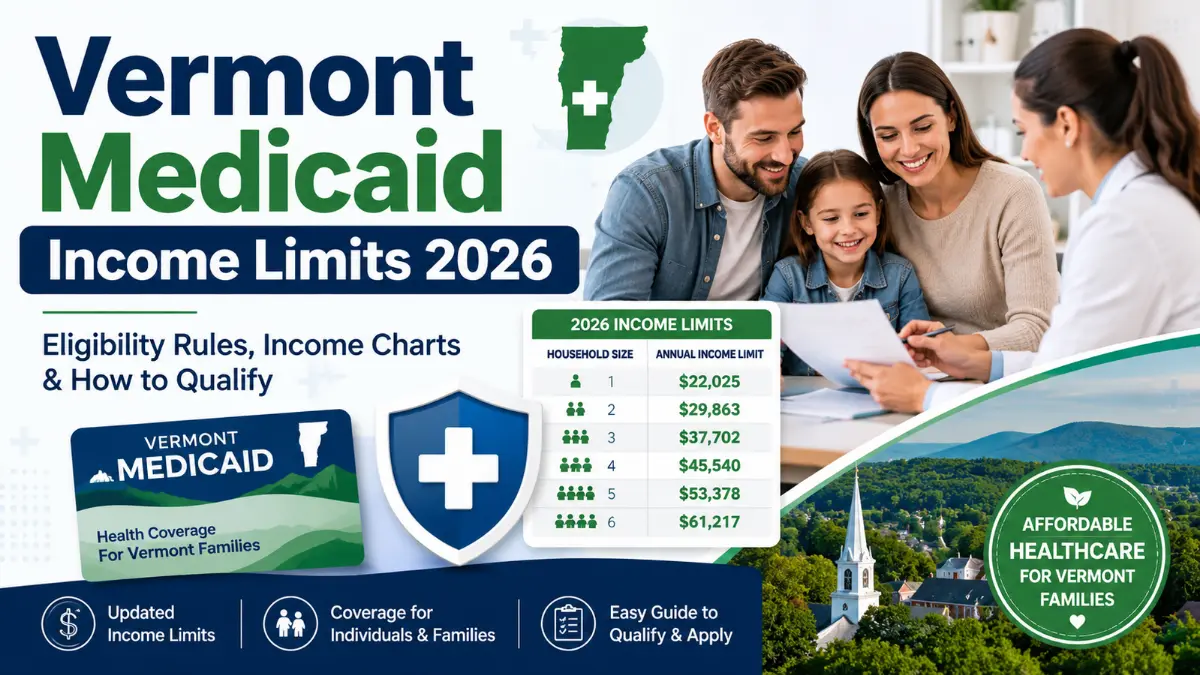
Vermont Medicaid income limits designed to help low income residents receive healthcare coverage, but eligibility depends on several factors not just your paycheck. Household size, age, pregnancy status, disability, and Medicaid expansion rules can all affect the outcome.
And yes, income calculations can be confusing. Hospital billing departments and Medicaid enrollment offices across the country regularly see applicants who are shocked to discover they’re either just below or just above the limit.
That’s because Medicaid doesn’t simply ask, “How much money do you make?” It looks at income through specific federal guidelines tied to the Federal Poverty Level (FPL), and those thresholds are updated every year.
What Is Vermont Medicaid income limits?
What many families don’t realize is that Medicaid isn’t one single program. It’s really a collection of coverage categories operating under the same system.
In Vermont, Medicaid helps eligible residents access healthcare services that might otherwise be financially out of reach.
Coverage may include:
- Primary care doctor visits
- Hospital services
- Emergency room treatment
- Prescription medications
- Mental health and behavioral health services
- Preventive screenings
- Maternity care
- Pediatric care for children
For many people, Medicaid becomes important during stressful moments. Parents often apply after a child’s medical diagnosis. Older adults may begin exploring long-term care options. And working adults sometimes discover they qualify after losing employer sponsored insurance.
At community clinics and enrollment centers, caseworkers frequently help families complete Medicaid applications while also answering questions about deductibles, income verification, and annual renewals.
The thing is, Vermont Medicaid operates under both federal guidelines and state-specific rules. So while Medicaid exists nationwide, income limits and eligibility categories can differ from one state to another.
That’s one reason applicants sometimes become confused after reading information meant for another state.
Why Income Limits Matter
Medicaid income limits are much more than numbers on a chart.
They determine:
- Who can receive healthcare coverage.
- Which Medicaid category applies.
- Whether Medicaid expansion rules come into play.
- Whether children or pregnant women qualify under higher thresholds.
And that’s where things sometimes become confusing. Inside hospital financial assistance departments, staff members regularly meet patients who say: “But my neighbor makes about the same amount and qualified.”
What they often discover is that household size, age, disability status, or pregnancy can dramatically change eligibility.
Income rules are based largely on the Federal Poverty Level (FPL), which is updated annually by the federal government. But not every Medicaid category works exactly the same way.
For example:
- Expansion Medicaid uses Modified Adjusted Gross Income (MAGI).
- Long-term care programs may include asset limits.
- Disability-related programs can follow different financial standards.
That’s why two families earning similar incomes may receive completely different eligibility decisions.
And while the process can feel frustrating, caseworkers reviewing applications are often looking at far more than a single number.
Vermont Medicaid Income Limits for Adults
Medicaid expansion changed healthcare access for many adults in Vermont. Before expansion, numerous low-income adults without children had few affordable insurance options. Today, adults between ages 19 and 64 may qualify if their household income falls near 138 percent of the Federal Poverty Level. What’s interesting is how often people’s income changes throughout the year. Seasonal employment, overtime pay, or reduced work hours can all affect eligibility. Enrollment workers often tell applicants not to assume they earn too much.
They’ve seen plenty of situations where families delayed applying for months, only to discover they actually qualified.
Estimated Medicaid Expansion Income Limits
| Household Size | Monthly Income | Annual Income |
|---|---|---|
| 1 | $1,835 | $22,025 |
| 2 | $2,489 | $29,863 |
| 3 | $3,142 | $37,702 |
| 4 | $3,795 | $45,540 |
| 5 | $4,448 | $53,378 |
| 6 | $5,101 | $61,217 |
These figures are estimates and may change as federal poverty guidelines are updated each year.
Medicaid Coverage for Children
Parents often discover something surprising during school physicals or pediatric appointments. Even when adults in the household don’t qualify, children sometimes do. That’s because children’s Medicaid programs frequently have higher income limits.
Coverage may include:
- Vaccinations
- Routine checkups
- Prescription medications
- Preventive care
- Specialist visits
Pediatric clinics and community health centers across Vermont regularly help families understand these rules. And caseworkers often say one of the biggest misconceptions they hear is:
“If I don’t qualify, my kids won’t either.” But that simply isn’t always true.
Coverage for Pregnant Women
Pregnancy is one of the areas where Medicaid rules become a little more flexible. What many families don’t realize is that pregnant women often qualify at higher income levels than other adults. That’s because both federal and state policymakers have long recognized the importance of prenatal care and healthy births.
Coverage may include:
- Prenatal visits
- Laboratory tests
- Ultrasounds
- Labor and delivery services
- Postpartum care
And yes, timing matters. Healthcare workers and enrollment counselors frequently encourage expectant mothers to apply as early as possible. Waiting too long can delay access to important services during pregnancy. In maternity clinics, it’s not unusual to hear someone say:
“I thought we made too much money.”
But after reviewing the household information, caseworkers sometimes find the applicant qualifies under pregnancy-related Medicaid rules.
Who Qualifies for Vermont Medicaid?
People often assume Medicaid eligibility is based only on income. The truth is, several categories exist, and each one has its own rules.
Adults Ages 19 to 64
Most working-age adults qualify under Vermont’s Medicaid expansion program. Income limits are largely based on the Federal Poverty Level (FPL), and eligibility is generally determined using Modified Adjusted Gross Income (MAGI).
Children
Children frequently qualify under higher income thresholds. That’s one reason parents are encouraged to apply even if they believe household earnings are too high.
Pregnant Women
Pregnant women usually receive more generous income limits because prenatal care is considered a priority.
Seniors
Older adults may qualify for certain Medicaid programs, including long-term care assistance.
But unlike standard Medicaid categories, these programs often involve additional financial reviews and asset limits.
Individuals With Disabilities
Disability-related Medicaid programs can follow different eligibility standards. Medical documentation, income, and sometimes resources are all considered during the review process.
That’s why eligibility decisions for people with disabilities can look very different from those for healthy adults.
What Counts as Income?
This is probably one of the biggest sources of confusion. Inside Medicaid enrollment offices, caseworkers spend a lot of time explaining that income doesn’t simply mean whatever appears in a bank account.
For many programs, Vermont Medicaid uses Modified Adjusted Gross Income (MAGI).
Income may include:
- Wages
- Self-employment earnings
- Unemployment benefits
- Certain Social Security benefits
- Investment income
What counts and what doesn’t can vary depending on the Medicaid category. That’s why two people with similar salaries may receive different decisions.
Hospital financial counselors often see delays happen because applicants accidentally report outdated earnings or forget about part-time jobs and seasonal work. And yes, mistakes happen more often than people realize.
How Household Size Affects Eligibility
At first glance, household size sounds simple. But anyone who has spent time talking with Medicaid caseworkers knows that this is one of the areas that creates the most questions.
For example:
- Single parents generally count themselves and their children.
- Married couples are usually counted together.
- Certain dependents may also be included.
Here’s where things become interesting. A single adult earning $23,000 annually may not qualify.
But a family of four earning much more could still fall within the income limits because the household size is larger.
That’s why eligibility workers often double-check applications before making final decisions. Household size and income work together. Looking at only one number rarely tells the full story.
How to Apply for Vermont Medicaid
These days, many applications are completed online.
But community health centers, hospitals, and local enrollment offices still help thousands of residents navigate the process each year.
Step 1: Gather Documents
Applicants should typically prepare:
- Photo identification
- Proof of income
- Residency documents
- Household information
Having documents ready can help avoid delays later.
Step 2: Submit an Application
Applications may be submitted online or through local assistance offices. Some hospitals and community organizations also provide enrollment assistance.
Step 3: Verification
Caseworkers review information and may request additional documents. This step sometimes surprises applicants who assume approval is immediate.
Step 4: Receive a Decision
Approval depends on:
- Income
- Household size
- Eligibility category
- Verification requirements
And yes, delays occasionally happen when employer records and reported income don’t match.
What If Your Income Is Too High?
Many families leave Medicaid offices believing they have no options. But that’s not always the case. Other programs may still help lower healthcare costs.
Possible alternatives include:
- ACA Marketplace plans
- Premium tax credits
- Children’s coverage programs
- Medicare Savings Programs
- Certain Medicaid pathways for people with disabilities
Healthcare navigators often tell people not to give up after one denial. Income changes. Programs change.
And annual updates to Medicaid thresholds mean eligibility can look different from one year to the next.
Common Mistakes to Avoid
Caseworkers and enrollment specialists see the same problems repeatedly.
Common mistakes include:
- Reporting old income instead of current income
- Forgetting part-time or seasonal earnings
- Miscounting household members
- Waiting too long to report changes
- Submitting incomplete paperwork
These issues can delay approval for weeks. And here’s something many applicants don’t realize: Most delays are caused by missing information not automatic denials. That’s why enrollment counselors often encourage families to respond quickly when additional documents are requested.
Vermont Cities Where Residents Seek Medicaid Assistance
Across Vermont, families often search for Medicaid help in:
- Burlington
- South Burlington
- Montpelier
- Rutland
- Barre
- Bennington
- St. Albans
- Brattleboro
- Essex
- Colchester
Even though Medicaid rules are statewide, the experience itself is often local. Community health centers, hospitals, and enrollment assistance offices in these areas regularly help residents understand eligibility requirements and complete applications.
And yes, location can sometimes affect how easy it is to find in-person assistance, even though the income rules themselves are the same across Vermont.
Official & Helpful Resources
FAQs ( Vermont Medicaid income limits)
What is the Vermont Medicaid income limit for one person?
This is probably the question eligibility workers hear most often. For a single adult, Medicaid expansion rules generally allow income up to around 138 percent of the Federal Poverty Level. In practical terms, that’s roughly $22,000 annually, although the exact amount can change each year when federal poverty guidelines are updated.
Does Vermont have Medicaid expansion?
Yes. Vermont is one of the states that expanded Medicaid under the Affordable Care Act. That expansion made a huge difference for many adults who previously had limited options for health insurance coverage. Today, adults without children can qualify based largely on income.
Can adults without children qualify?
Absolutely. Before Medicaid expansion, many childless adults fell into what healthcare advocates often called a “coverage gap.” Today, Vermont residents without dependents may qualify if their income falls within the expansion guidelines.
Do children have higher income limits?
They often do. Pediatric clinics and enrollment counselors frequently explain that children can qualify even when parents don’t.
Is there an asset limit?
For most Medicaid programs that use Modified Adjusted Gross Income (MAGI), assets are not the deciding factor. But some programs especially those involving long term care may have separate resource limits.
This distinction causes plenty of confusion because the rules aren’t identical across every Medicaid category.
Can I apply anytime?
Yes. Unlike many private insurance plans, Medicaid enrollment is available year-round. People don’t have to wait for an open enrollment period to submit an application.
That’s something enrollment specialists often remind patients who recently lost coverage or experienced major life changes.
What if my income changes?
Here’s the thing: Income changes are common. Seasonal work, overtime hours, reduced schedules, and new jobs can all affect eligibility.
Conclusion
Medicaid income limits can seem intimidating at first. After years of reporting on healthcare access and speaking with families sitting in waiting rooms, one thing becomes obvious: many people assume they won’t qualify without ever checking. And that’s understandable. The rules can be complicated. Income calculations differ by category. Programs for seniors and people with disabilities may work differently than expansion Medicaid. Children often qualify under higher limits. Pregnant women may have more flexibility. And annual updates to the Federal Poverty Level mean the numbers themselves change over time.
Apply.
Because assumptions are often wrong, and the only way to know for certain is to let the system review your specific situation. For many Vermont residents, that’s where the real answer begins.