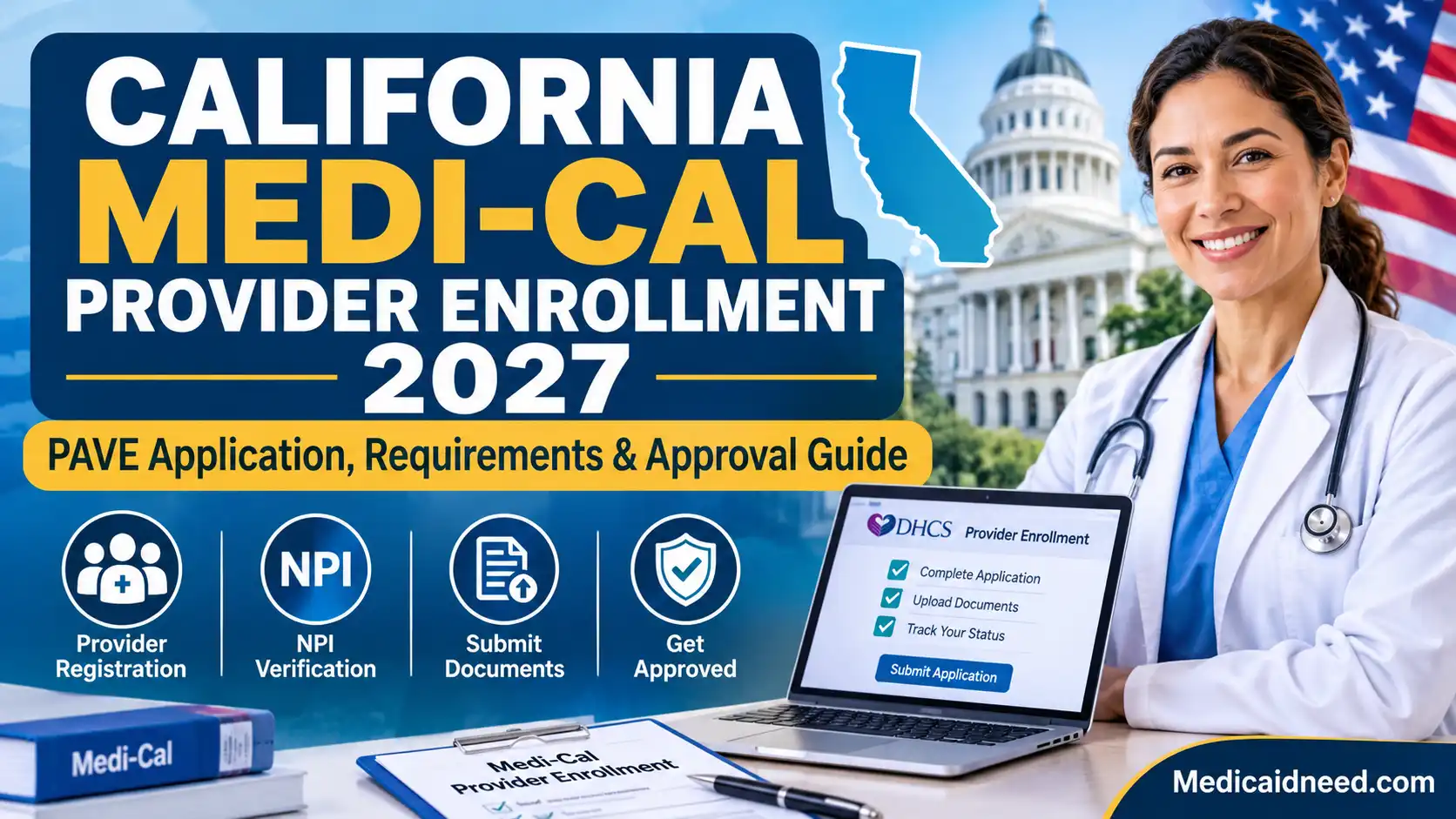
California Medi-Cal provider enrollment in 2027 comes down to one rule. If you order, refer, or prescribe for Medi-Cal members, you have to be enrolled with the state under your own Type 1 NPI. DHCS starts rolling out claim edits in the first quarter of 2027, and once they hit, claims tied to an unenrolled provider get denied.
This guide covers who’s affected, what the 2027 timeline looks like, and how to enroll. It also points out the mistakes that catch practices off guard. If you work in more than one state, the Medicaid provider enrollment by state in 2027 breakdown shows how other states handle the same federal requirement and rules.
What Is the Medi-Cal ORP Enrollment Requirement?
ORP stands for ordering, referring, and prescribing. Any licensed clinician who does one of those things for Medi-Cal members must be enrolled in Medi-Cal fee-for-service (FFS). You don’t have to bill Medi-Cal yourself.
Federal regulations have required this since 2013. Enforcement just hasn’t been consistent across the pharmacy, medical, and behavioral health claim systems, and DHCS wants that fixed. The 2027 rollout is the fix.
Three everyday situations trigger the rule:
- Ordering lab tests, durable medical equipment (DME), or home health services
- Sending a member to another clinician for care, which counts as referring
- Writing prescriptions that get filled through Medi-Cal Rx, the state’s pharmacy benefit
Medi-Cal has grown a lot over the past ten years, thanks in part to Medicaid expansion. More people enrolled means more paperwork—more orders, referrals, and prescriptions. And DHCS wants each of those linked to a clinician who’s registered in the system.
Who Must Enroll?
Physicians, nurse practitioners, physician assistants, dentists, and pharmacists who prescribe under their own authority all fall in. So do many other licensed clinicians who serve Medi-Cal members.
A few details trip people up:
- Managed care contracts don’t count. Neither does Medicare enrollment. You apply separately with DHCS.
- Medi-Cal Rx portal access isn’t enough. It gets you into the portal, but it doesn’t meet the enrollment requirement.
- Already enrolled as a rendering provider? You’re covered under your Type 1 NPI and don’t need a second ORP application.
- Nonprofit and FQHC clinicians must enroll. Employer type changes nothing if you order, refer, or prescribe.
- Residents with a postgraduate training license or a full license must enroll. Unlicensed trainees use a supervising enrolled provider’s NPI.
- Registered nurses, school nurses, and community health workers can’t enroll as ORP providers.
Not sure where your license type fits? DHCS keeps a page called Application Information by Provider Type that spells out the pathway for each one.
2027 Enforcement Timeline
Enforcement is phased. It starts in February 2027 and is planned to wrap up in the second quarter of 2028.
DHCS originally aimed for June 26, 2026, then backed off in favor of a phased approach. At its second town hall on September 24, 2026, the department laid out the new plan: phases by claim type, beginning in February 2027, with completion currently planned for Q2 2028.
| Start | Claim system | Who is affected first |
|---|---|---|
| Feb 2027 | Medical (CA-MMIS) | Providers ordering DME and clinical labs; providers referring for long-term care |
| Mar 2027 | Pharmacy (Medi-Cal Rx) | Prescribers other than physicians, PAs, NPs, pharmacists, students/residents, and dental providers |
| Apr 2027 | Medical (CA-MMIS) | Additional ordering and referring provider types |
| Jul 2027 | Pharmacy (Medi-Cal Rx) | All prescribers, with no exclusions |
| Oct 2027 | Short-Doyle (behavioral health) | Select specialty mental health and substance use services requiring ORP |
| Feb 2028 | Medical (CA-MMIS) | Remaining ordering and referring provider types |
Those dates are planned, not locked in, and DHCS has already moved its timeline once. Keep an eye on the DHCS Medi-Cal ORP page for changes.
Physicians and advanced practice clinicians aren’t in the March 2027 pharmacy group. Their turn comes in July 2027. Still, don’t wait for your phase to start. Applications take months.
What Happens If You’re Not Enrolled?
Once edits go live, claims tied to an unenrolled provider get denied. The damage doesn’t stop there.
Pharmacy prior authorization requests from an unenrolled prescriber get denied too. Other providers may also start checking enrollment before they act. A specialist can turn down your referral. A clinical lab can refuse to run tests you ordered, because the NPI on the claim can’t be processed.
Patients take the hit. If a prescription is denied because the prescriber isn’t enrolled, the member can pay out of pocket, but that cost isn’t reimbursable through a Conlan claim.
There is one safety valve. Pharmacies can approve emergency fills even when the prescriber isn’t enrolled, limited to a 14-day supply twice within 30 days.
An illustrative example
This example is hypothetical, not an official case. A nurse practitioner at a Sacramento clinic sees mostly Medi-Cal managed care patients and has never enrolled directly with DHCS. Her prescriptions go through fine today. When her phase’s claim edits start, pharmacy claims tied to her NPI get denied, and her patients wait while her application works through a review that takes months.
How to Enroll: Step by Step
Check the enrolled-provider list first. If your Type 1 NPI isn’t on it, apply online through DHCS’s PAVE portal.
- Confirm your Type 1 NPI. Look it up in the NPPES NPI Registry. DHCS needs your individual NPI, not your clinic’s Type 2 number.
- Check your status. Search your Type 1 NPI in the Profile of Enrolled Medi-Cal Fee-for-Service Providers dataset on the California Health and Human Services Open Data Portal. If you show up, the ORP requirement is met and you’re done.
- Create a PAVE account. Register at the PAVE portal. Every provider needs a unique username and password.
- Start the application. DHCS’s Ordering/Referring/Prescribing Only Enrollment Information page walks you to the right pathway.
- Sign and submit. Your office manager can prepare the application. You have to review it and sign it yourself, because signatures can’t be delegated.
Stuck somewhere? The DHCS Provider Enrollment Division takes questions through its Provider Inquiry Form.
Processing Time, Fees, and Effective Dates
Plan on three to six months. And no, ORP-only enrollment doesn’t cost anything.
- Timing: Physician applications typically get a response within 90 days. Nurse practitioners, physician assistants, and other license types typically take up to 180 days. Incomplete applications take longer.
- Fee: There’s no application fee for an ORP provider application.
- Effective date: For ORP enrollment, DHCS generally sets it one year before the day it receives your application, unless you weren’t licensed then. Other enrollment types usually start when DHCS receives a complete application.
- Submitting isn’t the finish line. DHCS has said an application submission alone doesn’t satisfy the requirement and can’t be used to override a pharmacy claim denial.
- Visibility: Approved applications show up in Medi-Cal Rx two days after approval. The public list takes about two weeks to update, so keep your DHCS approval letter handy. It counts as valid proof in the meantime.
The California Medical Association tells physicians the same thing: apply early, since enrollment can take up to 90 days.
One more thing worth knowing. Enrolling doesn’t set what you get paid for services. Rates come from the fee schedule, and the Medicaid fee schedule by state page is a good place to see how California’s rates stack up.
What Pharmacies, Labs, and Billing Staff Should Do
Billing teams carry a good share of this. Claims need the right NPI in the right spot.
Put a valid Type 1 NPI on every claim that needs an ordering or referring provider. A license number won’t work as a substitute on a medical claim. Check that your ordering and referring providers are enrolled before you submit anything.
Pharmacies already see warning messages when a prescriber isn’t enrolled. Use them. Tell those prescribers to apply before enforcement starts.
DME referrals deserve extra care. When several providers touch one referral, each person who orders, refers, or prescribes must be actively enrolled.
Keeping Your Enrollment Active
Signing up isn’t just a one-time thing. DHCS will let you know when it’s time, but that only works if they have your current contact info. So double-check that your details are up to date.
ORP enrollment belongs to you as an individual, not your employer. Change jobs and you generally don’t need to re-enroll. It also doesn’t obligate you to treat any set number of Medi-Cal members.
FAQs About California Medi-Cal provider enrollment for 2027
Do I need to enroll if I only prescribe for Medi-Cal managed care patients?
Yes. A managed care contract doesn’t meet the requirement. You enroll with DHCS under your individual Type 1 NPI, even if every patient you see is in a managed care plan.
Does Medicare enrollment count for Medi-Cal?
No. Medicare enrollment and Medi-Cal managed care participation both fall short. DHCS requires its own Medi-Cal fee-for-service enrollment, approved by its Provider Enrollment Division.
When does Medi-Cal provider enrollment enforcement begin?
The project kicks off in February 2027 and should wrap up sometime in the second quarter of 2028. When you get involved depends on your role and which billing system you use for your claims.
How long does Medi-Cal enrollment take?
Physician applications typically get a response within 90 days. Other license types typically take up to 180 days. Incomplete applications slow things down, so check everything before you sign.
Is there a fee to enroll as an ORP provider?
No. DHCS states there’s no application fee for ORP provider applications.
Can my office manager submit my application?
Staff can help you set things up, but you’ll have to make your own login, check your details, and sign off yourself. Nobody else is allowed to sign for you.
What if I’m already a Medi-Cal rendering provider?
You likely don’t need a separate ORP application. If your Type 1 NPI appears on the enrolled-provider list, DHCS considers the ORP requirement met.
Can a patient still get urgent medication from an unenrolled prescriber?
Yes, in an emergency. Pharmacies can approve fills of up to 14 days, twice within 30 days. It’s a short-term safeguard, not a replacement for enrollment.
Conclusion
Waiting is really the toughest part here. The rule isn’t complicated, but with that 90-to-180-day review period, if you get started early, you’re the clinician who never has to deal with denial headaches.
Look up your NPI on the enrolled-provider list today. If you’re not on it, open PAVE and start, then save your approval letter somewhere you can find it. Members have their own 2027 changes coming too, and the new Medicaid work requirements by state guide covers what they’re facing.
Disclaimer: This article offers general guidance about Medi-Cal provider enrollment for 2027 and is not legal, billing, or compliance advice. Enforcement schedule and requirements can change, and rules vary by provider type. Always verify your specific eligibility with the California Department of Health Care Services (DHCS) before relying on this detail.