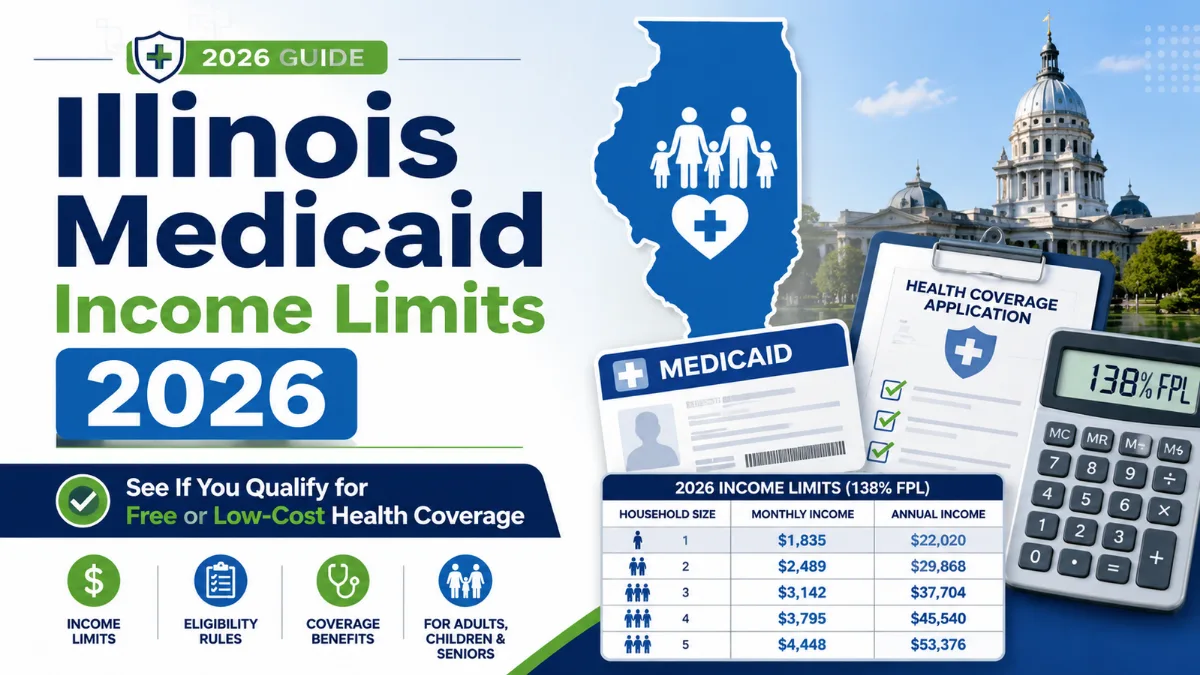
Illinois Medicaid guides people get free or very low cost health insurance. To qualify Illinois Medicaid Income Limits, your income, family size, age, and health condition all matter.
For most youth in Illinois, the income limit is based on 138 percent of the Federal Poverty Level (FPL). In 2026, this is about $1,835 per month for one person.
Different programs have different principles. Seniors, pregnant women, children, and people with disabilities may have different Medicaid income limits.
This guide helps Illinois Medicaid income limits in simple English so you can quickly see if you may qualify.
Illinois Medicaid Income Limits at a Glance
Most Common Medicaid Income Limits in Illinois
| Household Size | Monthly Income Limit | Annual Estimate |
|---|---|---|
| 1 | $1,835 | ~$22,020 |
| 2 | $2,489 | ~$29,868 |
| 3 | $3,142 | ~$37,704 |
| 4 | $3,795 | ~$45,540 |
| 5 | $4,448 | ~$53,376 |
These limits mostly apply to adults ages 19–64 under ACA Medicaid Expansion.
Who Qualifies for Illinois Medicaid?
Illinois Medicaid may help:
- Low-income adults
- Families with children
- Pregnant women
- Seniors age 65+
- Disabled individuals
- Children under 19
Illinois is a Medicaid Expansion state. This means adults without children may still qualify.
Illinois Medicaid for Adults (ACA Expansion)
This is the main Medicaid program for adults.
Basic Requirements
You usually must:
- Live in Illinois
- Meet income limits
- Be age 19–64
- Be a U.S. citizen or qualified immigrant
Important Advantage
Most adults do not have an asset test.
That means Illinois usually does not count:
- Savings accounts
- Cars
- Retirement money
Many people think they cannot qualify because they have savings, but that is often not true for ACA Medicaid.
What Counts as Income for Illinois Medicaid?
Illinois uses MAGI (Modified Adjusted Gross Income) for most Medicaid programs.
Counted Income May Include
- Job wages
- Self-employment income
- Unemployment benefits
- Social Security income
- Pension money
- Rental income
Income That May Not Count
Some things may not count, like:
- Certain tax refunds
- Some school grants
- Some lump-sum payments
If your income changes every month, Illinois may also look at your yearly income.
Monthly vs Annual Income: Which One Matters?
Illinois may look at both monthly and yearly income.
This helps when income changes often because of:
- Overtime
- Gig work
- Seasonal jobs
- Self-employment
For example, someone in Chicago who works different hours each month may still qualify.
Illinois Medicaid for Seniors and Disabled Adults
Seniors and disabled people may qualify through AABD Medicaid.
AABD means: Aid to the Aged, Blind, or Disabled
This program has different rules than regular adult Medicaid.
AABD Medicaid May Include
- Lower income limits
- Asset limits
- Bank account checks
- Long-term care reviews
Common Countable Assets
| Asset Type | Usually Counted? |
|---|---|
| Checking accounts | Yes |
| Savings accounts | Yes |
| Stocks and bonds | Yes |
| Second property | Yes |
| Primary home | Often exempt |
| One vehicle | Often exempt |
Illinois Medicaid Spend-Down Explained
If your income is a little too high, you may still qualify through a spend-down.
A spend-down is like a medical deductible.
Example
A senior in Springfield earns slightly over the limit. If medical bills are high enough, Medicaid may still help cover healthcare costs.
Spend-down programs are common for:
- Seniors
- Disabled people
- Nursing home care
Illinois Medicaid for Pregnant Women
Pregnant women can often qualify with higher income levels.
Coverage may include:
- Prenatal care
- Hospital delivery
- Postpartum care
- Prescription medicine
Even if a parent does not qualify for regular Medicaid, pregnancy Medicaid may still work.
All Kids Illinois: Medicaid Coverage for Children
All Kids Illinois gives healthcare coverage to children.
Children often qualify even if parents do not.
Benefits May Include
- Doctor visits
- Vaccines
- Dental care
- Vision care
- Emergency services
This program helps many families across Illinois.
Can You Get Illinois Medicaid If You Work?
Yes. Many people with jobs still qualify for Medicaid.
Having a job does not automatically disqualify you.
Illinois looks at:
- Household size
- Total income
- Program type
People working in Chicago, Aurora, Rockford, Peoria, and other Illinois cities may still qualify.
Does Illinois Medicaid Check Bank Accounts?
It depends on the Medicaid program.
ACA Adult Medicaid
Usually no asset check.
Seniors & Long-Term Care Medicaid
Bank accounts and savings are often reviewed.
Illinois may ask for:
- Bank statements
- Retirement account information
- Property records
How to Apply for Illinois Medicaid
You can apply anytime during the year.
Step 1: Gather Documents
You may need:
- ID
- Social Security number
- Proof of income
- Illinois address proof
Step 2: Apply Through Illinois ABE
The Illinois ABE Portal is the main website for Medicaid applications.
You can:
- Apply online
- Upload documents
- Renew benefits
- Report changes
You can also get help from:
- Hospitals
- Community clinics
- Medicaid offices near you
- Cook County Medicaid help centers
Step 3: Complete Income Verification
Illinois may ask for:
- Pay stubs
- Tax returns
- Employer letters
Missing paperwork is a common reason applications get delayed.
Common Reasons Illinois Medicaid Applications Get Denied
1. Wrong Income Information
Many people report net income instead of gross income.
2. Household Size Mistakes
Family size changes the income limit.
3. Missing Documents
Applications may be denied if paperwork is missing.
4. Income Changes Not Reported
Always report job or income changes quickly.
Medicaid vs ACA Marketplace Plans
If your income is too high for Medicaid, you may qualify for ACA Marketplace plans.
Quick Comparison
| Feature | Medicaid | ACA Marketplace |
|---|---|---|
| Monthly premiums | Usually free | Sometimes low-cost |
| Deductibles | Low or none | Depends on plan |
| Enrollment | Anytime | Open Enrollment |
| Income limits | Lower | Higher |
What Happens If Your Income Changes?
If your income changes, you should report it.
Examples include:
- New job
- More overtime
- Marriage
- New address
Some people still qualify even after income increases.
Rural vs Urban Medicaid Access in Illinois
Healthcare access may be different depending on where you live.
Chicago & Cook County
- More hospitals
- More specialists
- More Medicaid help centers
Rural Illinois
- Fewer doctors
- Longer travel times
- Smaller provider networks
Tips to Avoid Losing Illinois Medicaid Coverage
Keep Your Information Updated
Always update:
- Address
- Phone number
Watch Renewal Deadlines
Missing renewal forms can end coverage.
Save Important Records
Keep:
- Pay stubs
- Tax forms
- Medicaid letters
Helpful Resources
Frequently Asked Questions
What is the income limit for Medicaid in Illinois for one person?
For most adults, the limit is about $1,835 per month in 2026.
Is Illinois a Medicaid Expansion state?
Yes. Adults without children may still qualify based on income.
Does Illinois Medicaid have asset limits?
Regular ACA Medicaid usually does not. Seniors and long-term care programs often do.
Can self-employed people qualify for Illinois Medicaid?
Yes. Business expenses may lower countable income.
What happens if I make too much for Medicaid?
You may still qualify for:
- ACA Marketplace subsidies
- Spend-down Medicaid
- All Kids Illinois
- Pregnancy Medicaid
Does Illinois Medicaid count overtime pay?
Yes. Overtime is usually counted as income.
Can children qualify even if parents do not?
Yes. Children may still qualify through All Kids Illinois.
How often does Illinois Medicaid verify income?
Usually during:
- Application
- Renewal
- Reported income changes
Conclusion
Illinois Medicaid income limits depend on your household size, age, income, and Medicaid category. Most adults qualify based on 138 percent of the Federal Poverty Level, while seniors and disabled individuals may follow different principles.
Even if your income seems too high, you may still qualify through spend-down programs, pregnancy Medicaid, or All Kids Illinois.Before applying, gather your documents, check your income and use the Illinois ABE Portal to apply or renew coverage.