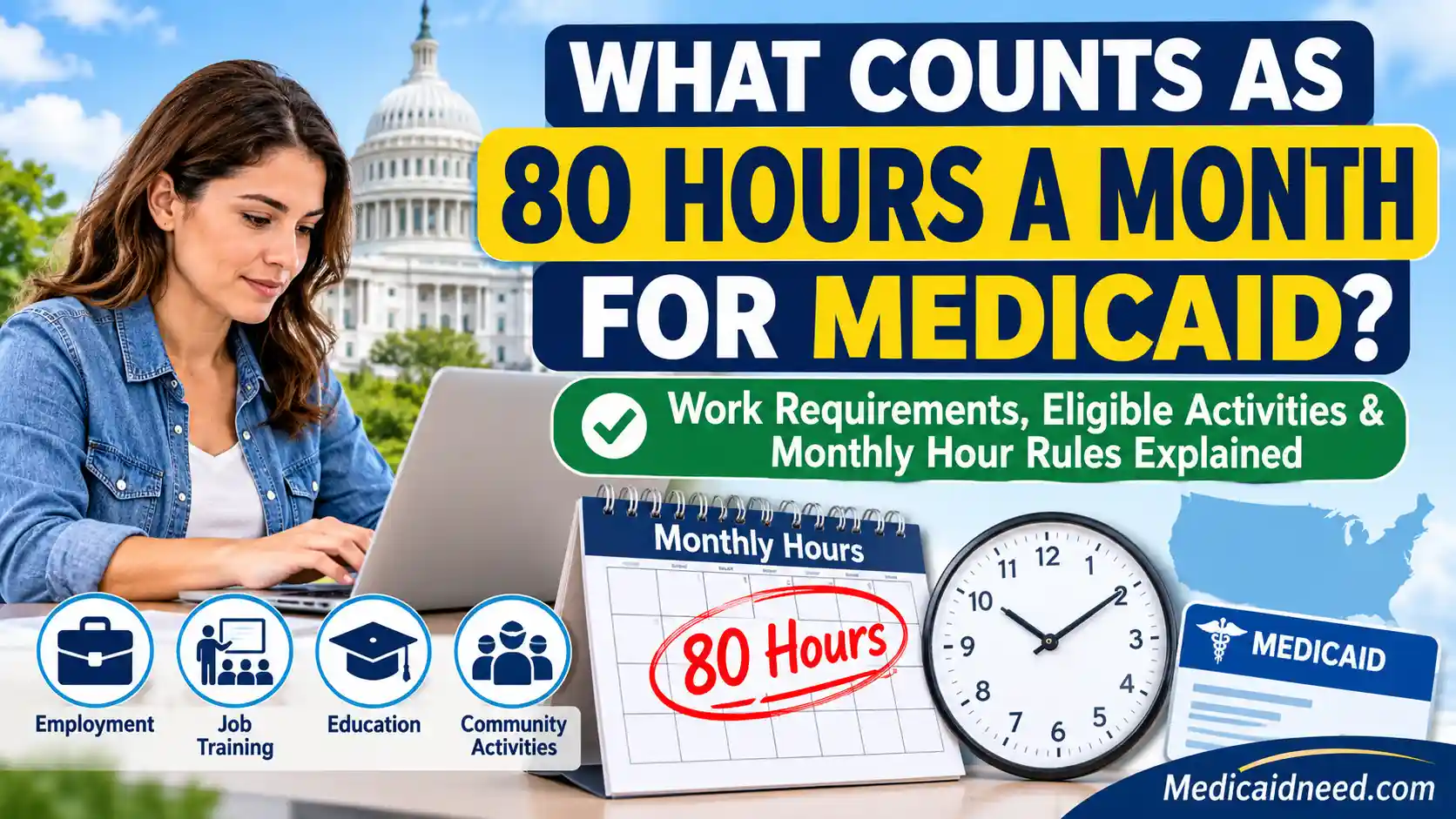
Lots of adults on Medicaid expansion coverage will soon have to prove 80 hours a month of qualifying activity to keep their benefits. Paid work counts. So does approved volunteering, job training, and school. And if you earn at least $580 a month in 2026, you don’t have to log any hours at all.
This guide covers what counts toward the Medicaid 80 hours, what doesn’t, and how the math works when you mix activities. Everything here comes from the federal rule CMS issued in June 2026.
What Is the Medicaid 80-Hour Requirement?
It’s a federal “community engagement” rule. Certain adults have to show at least 80 hours a month of work, community service, a work program, or school to get Medicaid or stay on it. Congress created it in the 2025 budget law, Public Law 119-21, also called the One Big Beautiful Bill Act.
CMS put out its interim final rule in the Federal Register on June 3, 2026. States have to start using the requirement by January 1, 2027. Some can start sooner if they meet certain conditions, and CMS has a process for a temporary good-faith exemption from that deadline.
Who Has to Meet the 80 Hours?
The rule is written for what the law calls “applicable individuals.” In plain terms, that’s adults ages 19 to 64 who get Medicaid through the Affordable Care Act’s expansion group, plus some adults in certain Section 1115 waiver programs. You can’t be pregnant, and you can’t be on Medicare.
Kids, people on Medicare, and people covered through most other Medicaid groups are left out. That includes parents and caretaker relatives under the traditional family categories. U.S. territories aren’t covered either.
Your state matters a lot here. Roughly 40 states and D.C. have expanded Medicaid, and our Medicaid expansion by state in 2027 breakdown shows where your state stands. Each state’s Medicaid agency decides how you report and prove your hours.
What Counts Toward the Medicaid 80 Hours?
Five paths count, and every state has to offer all five. Hit any one of them in a month and you’ve met the requirement.
| Path | What counts |
|---|---|
| Work | 80 hours of paid, in-kind, or unpaid work |
| Community service | 80 hours with a public or nonprofit program |
| Work program | 80 hours in a qualifying job or training program |
| School | Enrollment at least half-time |
| Income | Monthly income of at least 80 × the federal minimum wage ($580 in 2026) |
Can’t get to 80 hours with just one? You can mix them. Each path is explained below.
Does Work Count Toward the 80 Hours?
Yes, and the federal definition of “work” is wider than a regular job. Work for pay counts. Work in exchange for goods or services counts. Unpaid work counts too, as long as it isn’t community service.
Self-employment, gig work, and independent contracting all fit. So does in-kind work, like a building superintendent who gets reduced rent for doing the job.
An unpaid internship or a trial period before a hire? Those hours count. Unlike community service, unpaid work doesn’t have to help the community. It can benefit one private business and still qualify.
Does Volunteering Count?
It can, but the rules are picky. The volunteering has to be unpaid work in a structured program, done for the direct benefit of the community, and run by a public or nonprofit organization. That organization needs a way to track your hours and confirm them.
Food bank shifts, tutoring kids, delivering meals to seniors, cleaning up a public park. All good. Court-ordered community service counts too. And a state can’t say only 501(c)(3) groups are allowed, so local government agencies and religious nonprofits can qualify.
Here’s what doesn’t count:
- Helping a friend move or do yard work on your own
- Going to a parent-teacher conference or other school events for your child
- Joining a recreational club, like a dance or sports team
- Campaigning or volunteering for a partisan political candidate or committee
Do Job Training and Work Programs Count?
They do, as long as the program is on the approved list. The federal rule counts programs under the Workforce Innovation and Opportunity Act, certain Trade Act programs, SNAP Employment and Training programs, and employment and training programs run or supervised by a state. Qualifying veterans’ programs count as well.
Medicaid-covered supported employment services don’t count on their own. Neither do programs run by health providers that the state doesn’t operate or supervise.
Job searching gets limited credit. A supervised job search can be part of a work program, but it has to be less than half of the required hours. Job search you do to collect unemployment insurance can count if it follows the work program’s rules.
Does School Count?
Yes. Being enrolled at least half-time counts all by itself, and you don’t have to track a single hour. Your school decides whether you’re full-time, half-time, or less than half-time. The state doesn’t.
Colleges, career and technical programs, and high school all qualify. So do state-approved programs that lead to a high school equivalency certificate, like the GED. Studying on your own with a self-paced online course outside a state-approved program doesn’t count.
What If You’re Enrolled Less Than Half-Time?
Your classes still help. Those hours can be added to other activities.
If your program runs on credit hours, figure that each credit hour means about three hours of work per week. So, in a month, that’s around 13 hours for every credit hour you take (since there are about 4.33 weeks in a month). Programs without credit hours are simpler: class, lab, and training time count hour for hour.
How to Count Combined Hours
When no single activity gets you to 80, you add them up. Work, community service, work program time, and less-than-half-time school hours can all go into the pile.
Here’s an example, and it’s only an illustration, not an official case. Maria takes 4 credit hours at a community college, which comes to about 52 hours a month. She also works 30 hours at a part-time job. That’s roughly 82 hours, so she meets the requirement for the month.
The state tracks each activity separately, then adds them. And the rule is about hours per month, not per week.
The $580 Income Option
You can skip the hour counting if your income is high enough. The federal minimum wage is $7.25, and 80 hours times $7.25 is $580. Earn at least that in a month and you’ve met the requirement.
A few details trip people up:
- States have to use the federal minimum wage. They can’t swap in a higher state one.
- Income means household income under Medicaid’s MAGI method, so it isn’t only your own paycheck.
- Seasonal workers get a different test. The state can look at your average monthly income over the last six months.
What If You Earn Less Than $580?
Low income still helps. If the state has your income but not your hours, it can turn your income into estimated work hours by dividing by $7.25.
Take $380 in monthly income. That equals about 52 hours of work, so you’d need roughly 28 more hours from something else, like volunteering. States can only do this when they don’t have your real hours.
Who May Not Need to Meet the 80 Hours?
Federal law carves out several groups. Some are fully excluded from the rule, and others get an exception for certain months. The main groups are:
- Former foster youth under age 26
- Certain parents and family caregivers of a child 13 or younger, or of a person with a disability
- Veterans with a total disability rating
- People who are medically frail or have special medical needs
- Recently incarcerated people, for a limited time after release
The medical frailty exemption has a catch. CMS says you need a qualifying condition that significantly limits your ability to meet the 80 hours. A diagnosis alone isn’t enough. States can also add short-term hardship exceptions.
Caregiving can count as unpaid work when you don’t qualify for the exclusion. If you’re caring for a child under 13 or someone with a disability, and your caregiving hours don’t reach the exclusion limit, you can count those hours toward your total 80.
The definitions are detailed, so confirm your status with your state agency before you assume anything.
How Will States Check Your Hours?
States start with data they already have, like wage records. If that doesn’t settle it, they can ask you for documents.
When a state can’t verify that you comply, it has to send a notice of noncompliance. You get 30 calendar days to show you meet the requirement or qualify for an exception. Get disenrolled anyway? You can reapply any time.
Checks happen at application and at renewal, and states can choose to check more often.
Keep your paperwork. Pay stubs, work schedules, volunteer logs signed by a coordinator, class schedules, and attendance sheets from a work program all do the job. Start a folder now.
Dates and processes differ from state to state, so see our guide to new Medicaid work requirements by state to find your state’s timeline.
Frequently Asked Questions
How many hours do you need to work to keep Medicaid?
If the rule applies to you, it’s 80 hours a month of qualifying activity, or income of at least $580 a month in 2026. Exempt groups don’t have to meet it.
Does volunteering count toward the Medicaid 80 hours?
Yes, when it’s structured community service with a public or nonprofit group that tracks your hours. Helping a neighbor on your own doesn’t count. Court-ordered community service does.
Can I combine work, school, and volunteering?
Yes. Any mix of work, community service, work program hours, and less-than-half-time school hours can add up to 80. If you’re enrolled at least half-time, you’re already done and don’t need to add anything.
Does self-employment or gig work count?
Yes. Self-employment, contracting, and work paid in goods or services all count. Your state may check your hours through income records.
Does looking for a job count?
Only in a small way. Job search can be part of a qualifying work program if it’s less than half the required hours. Job search for unemployment insurance counts when it follows the work program’s rules.
Do I have to work 20 hours every week?
No. The federal rule counts hours per month and doesn’t set a weekly schedule. Your state sets how it reviews your hours.
What happens if I don’t meet the 80 hours?
You get a notice and 30 days to show you comply or qualify for an exception. If you still can’t, you can be denied or disenrolled. You can reapply at any time.
When does the Medicaid work requirement start?
States must start by January 1, 2027. Some begin earlier, and CMS has a process for a temporary good-faith exemption from the deadline. Your state Medicaid agency can give you the exact date.
Conclusion
Most people read “80 hours” and picture a rigid job requirement. It isn’t one. A mix of part-time work, a class, and a few volunteer shifts can get you there, and $580 in monthly income gets you there with no tracking at all.
Do one thing this week: find out whether your state has announced its start date and reporting process. If you work with Medicaid on the provider side, our Medicaid fee schedule by state and Medicaid provider enrollment by state 2027 guides cover the next steps. For the full rule text, read the federal interim final rule or visit Medicaid.gov.
Official Resources
- Verify the Federal Rule — Federal Register
- Check Official Medicaid Updates — Medicaid.gov
- Find Your State Medicaid Office — HealthCare.gov
- See Other Benefits You May Qualify For — Benefits.gov
Disclaimer: This article gives general information based on the federal interim final rule published in June 2026. It isn’t legal or benefits advice. State rules, start dates, and procedures vary, and requirements can change, so confirm your situation with your state Medicaid agency.